


Page 311 -
P. 311
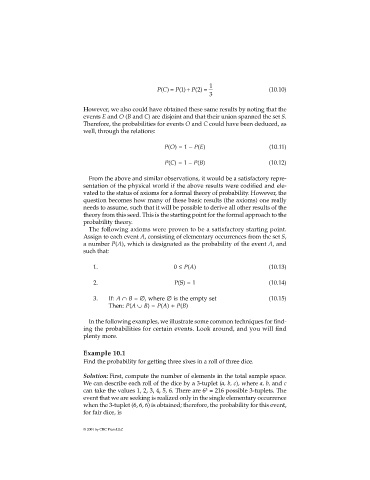
PC() =  P( ) +1  P( ) =2  1          (10.10)
                                                                      3

                             However, we also could have obtained these same results by noting that the
                             events E and O (B and C) are disjoint and that their union spanned the set S.
                             Therefore, the probabilities for events O and C could have been deduced, as
                             well, through the relations:


                                                       P(O) = 1 – P(E)                    (10.11)

                                                        P(C) = 1 – P(B)                   (10.12)

                              From the above and similar observations, it would be a satisfactory repre-
                             sentation of the physical world if the above results were codified and ele-
                             vated to the status of axioms for a formal theory of probability. However, the
                             question becomes how many of these basic results (the axioms) one really
                             needs to assume, such that it will be possible to derive all other results of the
                             theory from this seed. This is the starting point for the formal approach to the
                             probability theory.
                              The following axioms were proven to be a satisfactory starting point.
                             Assign to each event A, consisting of elementary occurrences from the set S,
                             a number P(A), which is designated as the probability of the event A, and
                             such that:

                                1.                         0 ≤ P(A)                       (10.13)


                                2.                         P(S) = 1                       (10.14)

                                3.   If: A ∩ B = ∅, where ∅ is the empty set              (10.15)
                                     Then: P(A ∪ B) = P(A) + P(B)


                              In the following examples, we illustrate some common techniques for find-
                             ing the probabilities for certain events. Look around, and you will find
                             plenty more.

                             Example 10.1
                             Find the probability for getting three sixes in a roll of three dice.

                             Solution: First, compute the number of elements in the total sample space.
                             We can describe each roll of the dice by a 3-tuplet (a, b, c), where a, b, and c
                             can take the values 1, 2, 3, 4, 5, 6. There are 6  = 216 possible 3-tuplets. The
                                                                     3
                             event that we are seeking is realized only in the single elementary occurrence
                             when the 3-tuplet (6, 6, 6) is obtained; therefore, the probability for this event,
                             for fair dice, is


                             © 2001 by CRC Press LLC

