


Page 306 -
P. 306
′
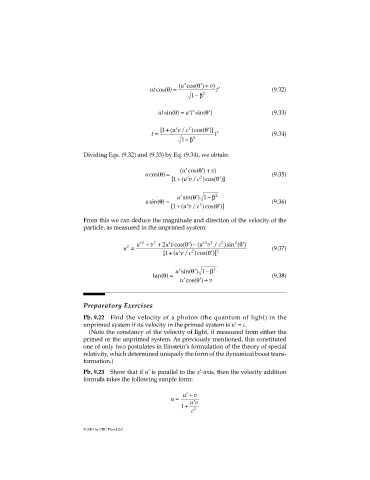
                                                             u ( cos( )θ′ +  v)
                                                   utcos( )θ =           t′                (9.32)
                                                                1 − β 2
                                                     utsin( )θ = ′′                        (9.33)
                                                              u t sin( )θ′

                                                           ′
                                                   t =  [1 + ( uv c/  2 )cos(θ ′)] t′      (9.34)
                                                             1 − β  2

                             Dividing Eqs. (9.32) and (9.33) by Eq. (9.34), we obtain:

                                                                   θ′
                                                              ′
                                                             u ( cos( ) +  v)
                                                 ucos( ) θ =                               (9.35)
                                                          [ +1  ( ′  /  2  θ′
                                                              uv c )cos( )]
                                                             ′
                                                            u sin( )θ′ 1 − β  2
                                                 usin( )θ =                                (9.36)
                                                              uv c/
                                                          [ +1  ( ′  2 )cos( )]θ′
                             From this we can deduce the magnitude and direction of the velocity of the
                             particle, as measured in the unprimed system:


                                                                    ′
                                              u′ + v +  2 u v ′ cos(θ ′ −) ( u v / c )sin (θ ′)
                                                                       2
                                                2
                                                                          2
                                                    2
                                                                     2
                                                                               2
                                          u =                                              (9.37)
                                           2
                                                                2
                                                       [ 1+ ( uv c )cos(θ ′)] 2
                                                            ′ /
                                                            ′ u  sin( )θ′ 1 − β  2
                                                    tan( )θ =                              (9.38)
                                                              ′ u  cos( )θ′ + v
                             Preparatory Exercises
                             Pb. 9.22 Find the velocity of a photon (the quantum of light) in the
                             unprimed system if its velocity in the primed system is u′ = c.
                              (Note the constancy of the velocity of light, if measured from either the
                             primed or the unprimed system. As previously mentioned, this constituted
                             one of only two postulates in Einstein’s formulation of the theory of special
                             relativity, which determined uniquely the form of the dynamical boost trans-
                             formation.)
                             Pb. 9.23 Show that if u′ is parallel to the x′-axis, then the velocity addition
                             formula takes the following simple form:

                                                              u′ +  v
                                                          u =   uv ′
                                                             1 +  2
                                                                c


                             © 2001 by CRC Press LLC

