


Page 317 -
P. 317
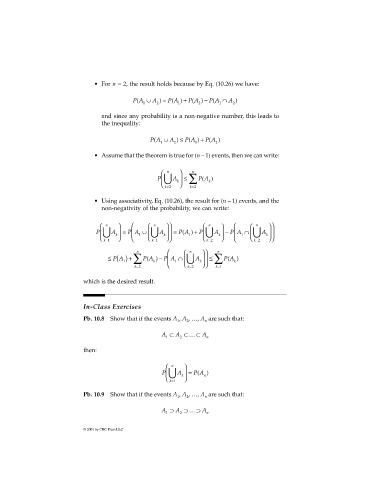
• For n = 2, the result holds because by Eq. (10.26) we have:
PA( ∪ A ) = P A( ) + P A( ) − P A( ∩ A )
1 2 1 2 1 2
and since any probability is a non-negative number, this leads to
the inequality:
PA( ∪ A ) ≤ P A( ) + P A( )
1 2 1 2
• Assume that the theorem is true for (n – 1) events, then we can write:
n n
≤
P U A k ∑ P A( k )
k=2 k=2
• Using associativity, Eq. (10.26), the result for (n – 1) events, and the
non-negativity of the probability, we can write:
n n n n
P A ∪
P A ∩
P A +
k
k
P U A k = 1 U A = ( 1 ) P U A k − 1 U A
k=1 k=1 k=2 k=2
n
n
k ∑
P A ∩
≤ PA ( ) + ∑ P A − 1 U A ≤ n PA( )
)
(
1 k k
k=2 k=2 k =1
which is the desired result.
In-Class Exercises
Pb. 10.8 Show that if the events A , A , …, A are such that:
2
1
n
A ⊂ A ⊂ … ⊂ A
1 2 n
then:
n
P U A k = P A( n )
k=1
Pb. 10.9 Show that if the events A , A , …, A are such that:
1
n
2
A ⊃ A ⊃… ⊃ A
1 2 n
© 2001 by CRC Press LLC

