


Page 187 - Elements of Distribution Theory
P. 187
P1: JZP
            052184472Xc06  CUNY148/Severini  May 24, 2005  2:41


                                             6.2 Discrete Time Stationary Processes          173


                                             = 0                               = 0.5


                           x t                                 x t
                              −                                   −
                              −                                   −

                                           t                                   t
                                           = −0.5                              = 0.9


                           x t                                 x t
                              −                                   −
                              −                                   −

                                           t                                   t
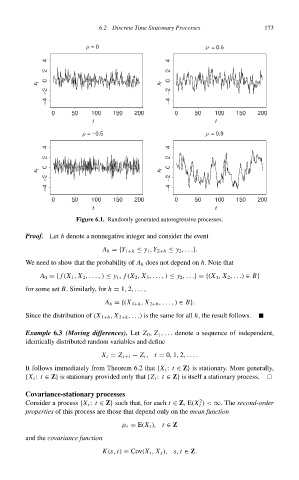
                                       Figure 6.1. Randomly generated autoregressive processes.

                        Proof. Let h denote a nonnegative integer and consider the event
                                              A h ={Y 1+h ≤ y 1 , Y 2+h ≤ y 2 ,...}.

                        We need to show that the probability of A h does not depend on h. Note that
                            A 0 ={ f (X 1 , X 2 ,..., ) ≤ y 1 , f (X 2 , X 3 ,..., ) ≤ y 2 ,...}={(X 1 , X 2 ,...) ∈ B}
                        for some set B. Similarly, for h = 1, 2,...,

                                               A h ={(X 1+h , X 2+h ,..., ) ∈ B}.
                        Since the distribution of (X 1+h , X 2+h ,...)is the same for all h, the result follows.

                        Example 6.3 (Moving differences). Let Z 0 , Z 1 ,... denote a sequence of independent,
                        identically distributed random variables and define
                                              X t = Z t+1 − Z t , t = 0, 1, 2,....
                        It follows immediately from Theorem 6.2 that {X t : t ∈ Z} is stationary. More generally,
                        {X t : t ∈ Z} is stationary provided only that {Z t : t ∈ Z} is itself a stationary process.

                        Covariance-stationary processes
                                                                          2
                        Consider a process {X t : t ∈ Z} such that, for each t ∈ Z,E(X ) < ∞. The second-order
                                                                          t
                        properties of this process are those that depend only on the mean function
                                                    µ t = E(X t ), t ∈ Z
                        and the covariance function

                                              K(s, t) = Cov(X t , X s ), s, t ∈ Z.

