


Page 171 - Encyclopedia of Chemical Compounds 3 Vols
P. 171
BUTANE


                                       90 percent) of methane. Other components include ethane
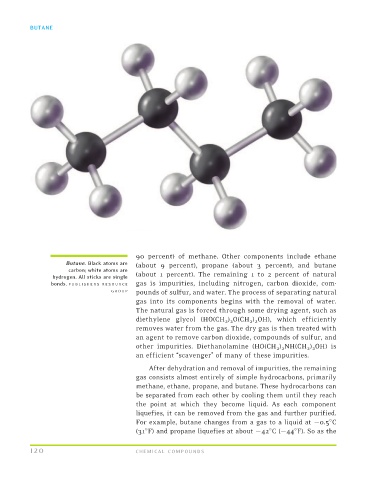
                   Butane. Black atoms are
                                       (about 9 percent), propane (about 3 percent), and butane
                    carbon; white atoms are
                hydrogen. All sticks are single  (about 1 percent). The remaining 1 to 2 percent of natural
               bonds. PUB L I S H E RS RE SO URCE  gas is impurities, including nitrogen, carbon dioxide, com-
                                GRO U P  pounds of sulfur, and water. The process of separating natural
                                       gas into its components begins with the removal of water.
                                       The natural gas is forced through some drying agent, such as
                                       diethylene glycol (HO(CH 2 ) 2 O(CH 2 ) 2 OH), which efficiently
                                       removes water from the gas. The dry gas is then treated with
                                       an agent to remove carbon dioxide, compounds of sulfur, and
                                       other impurities. Diethanolamine (HO(CH 2 ) 2 NH(CH 2 ) 2 OH) is
                                       an efficient ‘‘scavenger’’ of many of these impurities.
                                          After dehydration and removal of impurities, the remaining
                                       gas consists almost entirely of simple hydrocarbons, primarily
                                       methane, ethane, propane, and butane. These hydrocarbons can
                                       be separated from each other by cooling them until they reach
                                       the point at which they become liquid. As each component
                                       liquefies, it can be removed from the gas and further purified.

                                       For example, butane changes from a gas to a liquid at  0.5 C

                                       (31 F) and propane liquefies at about  42 C( 44 F). So as the

         120                           CHEMICAL COMPOUNDS

