


Page 176 - Encyclopedia of Chemical Compounds 3 Vols
P. 176
O  H H      H
                                                     H C     C     C   C    C   CH 3
                                                       3
                                                                O  H H      H


                    OTHER NAMES:
                Three forms exist;
                     see Overview
                        FORMULA:
             C 6 H 12 O 2 ; see Overview
                    for expanded
                        formulas
                       ELEMENTS:
                Carbon, hydrogen,        Butyl Acetate
                         oxygen
                  COMPOUND TYPE:
                  Carboxylic acids
                                         OVERVIEW
                          STATE:
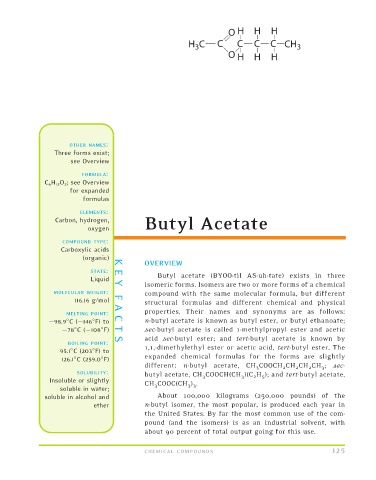
                                             Butyl acetate (BYOO-til AS-uh-tate) exists in three
                        (organic) KE
                          Liquid
                                         isomeric forms. Isomers are two or more forms of a chemical
                                 Y
                                         compound with the same molecular formula, but different
                      116.16 g/mol       structural formulas and different chemical and physical
                MOLECULAR WEIGHT: F
                                         properties. Their names and synonyms are as follows:
                                 A


               98.9 C( 146 F) to         n-butyl acetate is known as butyl ester, or butyl ethanoate;
                   MELTING POINT: C

                   78 C( 108 F)  T       sec-butyl acetate is called 1-methylpropyl ester and acetic
                                         acid sec-butyl ester; and tert-butyl acetate is known by
                    BOILING POINT:
                                 S
                                         1,1,-dimethylethyl ester or acetic acid, tert-butyl ester. The
                  95.1 C (203 F) to


                  126.1 C (259.0 F)      expanded chemical formulas for the forms are slightly
                                         different: n-butyl acetate, CH 3 COOCH 2 CH 2 CH 2 CH 3 ; sec-
                      SOLUBILITY:
                                         butyl acetate, CH 3 COOCH(CH 3 )(C 2 H 5 ); and tert-butyl acetate,
               Insoluble or slightly
                                         CH 3 COOC(CH 3 ) 3 .
                  soluble in water;
             soluble in alcohol and          About 100,000 kilograms (250,000 pounds) of the
                           ether         n-butyl isomer, the most popular, is produced each year in
                                         the United States. By far the most common use of the com-
                                         pound (and the isomers) is as an industrial solvent, with
                                         about 90 percent of total output going for this use.
                                         CHEMICAL COMPOUNDS                                  125

