


Page 185 - Encyclopedia of Chemical Compounds 3 Vols
P. 185
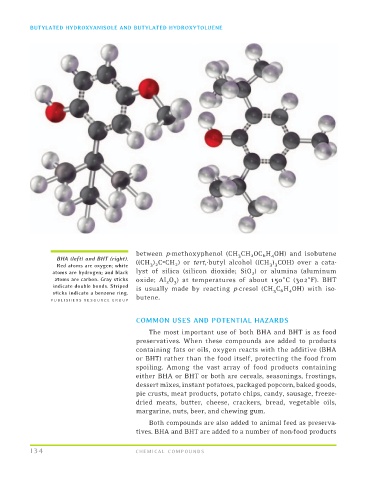
BUTYLATED HYDROXYANISOLE AND BUTYLATED HYDROXYTOLUENE


                                       between p-methoxyphenol (CH 3 CH 2 OC 6 H 4 OH) and isobutene
                 BHA (left) and BHT (right).
                 Red atoms are oxygen; white  ((CH 3 ) 2 C=CH 2 )or tert,-butyl alcohol ((CH 3 ) 3 COH) over a cata-
                atoms are hydrogen; and black  lyst of silica (silicon dioxide; SiO 2 ) or alumina (aluminum


                atoms are carbon. Gray sticks  oxide; Al 2 O 3 ) at temperatures of about 150 C (302 F). BHT
                indicate double bonds. Striped  is usually made by reacting p-cresol (CH 3 C 6 H 4 OH) with iso-
                sticks indicate a benzene ring.
                                       butene.
               PUBLISHERS RESOURCE GRO U P
                                       COMMON USES AND POTENTIAL HAZARDS
                                          The most important use of both BHA and BHT is as food
                                       preservatives. When these compounds are added to products
                                       containing fats or oils, oxygen reacts with the additive (BHA
                                       or BHT) rather than the food itself, protecting the food from
                                       spoiling. Among the vast array of food products containing
                                       either BHA or BHT or both are cereals, seasonings, frostings,
                                       dessertmixes,instantpotatoes,packagedpopcorn,bakedgoods,
                                       pie crusts, meat products, potato chips, candy, sausage, freeze-
                                       dried meats, butter, cheese, crackers, bread, vegetable oils,
                                       margarine, nuts, beer, and chewing gum.
                                          Both compounds are also added to animal feed as preserva-
                                       tives. BHA and BHT are added to a number of non-food products


         134                           CHEMICAL COMPOUNDS

