


Page 202 - Encyclopedia of Chemical Compounds 3 Vols
P. 202
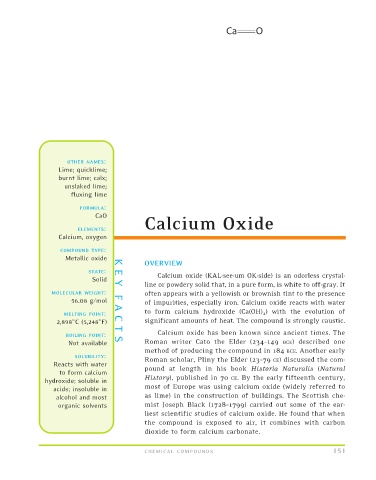
Ca      O


                    OTHER NAMES:
                 Lime; quicklime;
                 burnt lime; calx;
                   unslaked lime;
                     fluxing lime

                       FORMULA:
                           CaO
                                         Calcium Oxide
                       ELEMENTS:
                 Calcium, oxygen
                  COMPOUND TYPE:
                   Metallic oxide
                                         OVERVIEW
                          STATE:  KE
                                             Calcium oxide (KAL-see-um OK-side) is an odorless crystal-
                           Solid
                                         line or powdery solid that, in a pure form, is white to off-gray. It
                                 Y
                                         often appears with a yellowish or brownish tint to the presence
                     56.08 g/mol         of impurities, especially iron. Calcium oxide reacts with water
               MOLECULAR WEIGHT: F
                                         to form calcium hydroxide (Ca(OH) 2 ) with the evolution of
                                 A

                 2,898 C(5,248 F)        significant amounts of heat. The compound is strongly caustic.
                   MELTING POINT: C
                                             Calcium oxide has been known since ancient times. The
                                 T
                    Not available        Roman writer Cato the Elder (234–149 BCE) described one
                   BOILING POINT: S
                                         method of producing the compound in 184 BCE. Another early
                      SOLUBILITY:
                                         Roman scholar, Pliny the Elder (23–79 CE) discussed the com-
                Reacts with water
                                         pound at length in his book Historia Naturalis (Natural
                 to form calcium
                                         History), published in 70 CE. By the early fifteenth century,
             hydroxide; soluble in
                                         most of Europe was using calcium oxide (widely referred to
                acids; insoluble in
                 alcohol and most        as lime) in the construction of buildings. The Scottish che-
                 organic solvents        mist Joseph Black (1728–1799) carried out some of the ear-
                                         liest scientific studies of calcium oxide. He found that when
                                         the compound is exposed to air, it combines with carbon
                                         dioxide to form calcium carbonate.
                                         CHEMICAL COMPOUNDS                                  151

