


Page 203 - Encyclopedia of Chemical Compounds 3 Vols
P. 203
CALCIUM OXIDE


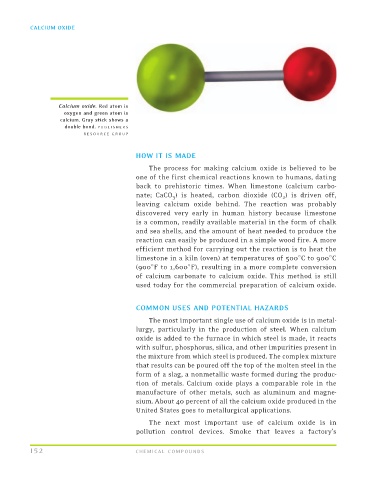
                 Calcium oxide. Red atom is
                   oxygen and green atom is
                  calcium. Gray stick shows a
                   double bond. PU BL I S HERS
                        RESOURCE GRO U P

                                       HOW IT IS MADE

                                          The process for making calcium oxide is believed to be
                                       one of the first chemical reactions known to humans, dating
                                       back to prehistoric times. When limestone (calcium carbo-
                                       nate; CaCO 3 ) is heated, carbon dioxide (CO 2 ) is driven off,
                                       leaving calcium oxide behind. The reaction was probably
                                       discovered very early in human history because limestone
                                       is a common, readily available material in the form of chalk
                                       and sea shells, and the amount of heat needed to produce the
                                       reaction can easily be produced in a simple wood fire. A more
                                       efficient method for carrying out the reaction is to heat the


                                       limestone in a kiln (oven) at temperatures of 500 C to 900 C


                                       (900 F to 1,600 F), resulting in a more complete conversion
                                       of calcium carbonate to calcium oxide. This method is still
                                       used today for the commercial preparation of calcium oxide.
                                       COMMON USES AND POTENTIAL HAZARDS
                                          The most important single use of calcium oxide is in metal-
                                       lurgy, particularly in the production of steel. When calcium
                                       oxide is added to the furnace in which steel is made, it reacts
                                       with sulfur, phosphorus, silica, and other impurities present in
                                       the mixture from which steel is produced. The complex mixture
                                       that results can be poured off the top of the molten steel in the
                                       form of a slag, a nonmetallic waste formed during the produc-
                                       tion of metals. Calcium oxide plays a comparable role in the
                                       manufacture of other metals, such as aluminum and magne-
                                       sium. About 40 percent of all the calcium oxide produced in the
                                       United States goes to metallurgical applications.
                                          The next most important use of calcium oxide is in
                                       pollution control devices. Smoke that leaves a factory’s


         152                           CHEMICAL COMPOUNDS

