


Page 313 - Facility Piping Systems Handbook for Industrial, Commercial, and Healthcare Facilities
P. 313
SITE UTILITY SYSTEMS

                                                SITE UTILITY SYSTEMS                 6.35

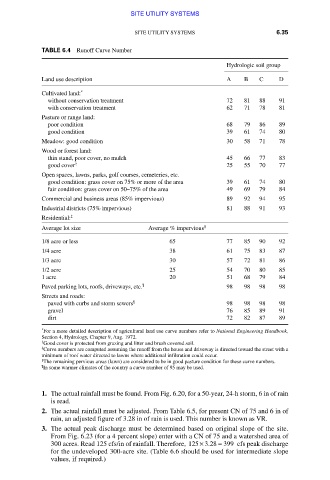
                        TABLE 6.4  Runoff Curve Number

                                                                        Hydrologic soil group
                        Land use description                            A    B   C    D
                        Cultivated land: *
                          without conservation treatment                72   81   88   91
                          with conservation treatment                   62   71   78   81
                        Pasture or range land:
                         poor condition                                 68   79   86   89
                         good condition                                 39   61   74   80
                        Meadow: good condition                          30   58   71   78
                        Wood or forest land:
                          thin stand, poor cover, no mulch              45   66   77   83
                         good cover †                                   25   55  70   77
                        Open spaces, lawns, parks, golf courses, cemeteries, etc.
                          good condition: grass cover on 75% or more of the area   39   61   74   80
                          fair condition: grass cover on 50–75% of the area    49   69   79   84
                        Commercial and business areas (85% impervious)     89   92   94   95
                        Industrial districts (75% impervious)           81   88   91   93
                        Residential: ‡
                        Average lot size            Average % impervious §
                        1/8 acre or less                 65             77   85   90   92
                        1/4 acre                         38             61   75   83   87
                        1/3 acre                         30             57   72   81   86
                        1/2 acre                         25             54   70   80   85
                        1 acre                           20             51   68   79   84
                        Paved parking lots, roofs, driveways, etc. ¶    98   98  98   98
                        Streets and roads:
                          paved with curbs and storm sewers ¶           98   98  98   98
                         gravel                                         76   85   89   91
                         dirt                                           72   82   87   89
                        *
                        For a more detailed description of agricultural land use curve numbers refer to National Engineering Handbook,
                        Section 4, Hydrology, Chapter 9, Aug. 1972.
                        †
                        Good cover is protected from grazing and litter and brush covered soil.
                        ‡
                        Curve numbers are computed assuming the runoff from the house and driveway is directed toward the street with a
                        minimum of roof water directed to lawns where additional infiltration could occur.
                        §
                        The remaining pervious areas (lawn) are considered to be in good pasture condition for these curve numbers.
                        ¶
                        In some warmer climates of the country a curve number of 95 may be used.
                        1.  The actual rainfall must be found. From Fig. 6.20, for a 50-year, 24-h storm, 6 in of rain
                          is read.
                        2.  The actual rainfall must be adjusted. From Table 6.5, for present CN of 75 and 6 in of
                          rain, an adjusted figure of 3.28 in of rain is used. This number is known as VR.
                        3.  The actual peak discharge must be determined based on original slope of the site.
                          From Fig. 6.23 (for a 4 percent slope) enter with a CN of 75 and a watershed area of
                          300 acres. Read 125 cfs/in of rainfall. Therefore, 125 3 28 399× .  =   cfs peak discharge
                          for the undeveloped 300-acre site. (Table 6.6 should be used for intermediate slope
                          values, if required.)


                     Downloaded from Digital Engineering Library @ McGraw-Hill (www.accessengineeringlibrary.com)
                                Copyright © 2009 The McGraw-Hill Companies. All rights reserved.
                                  Any use is subject to the Terms of Use as given at the website.

