


Page 336 - Facility Piping Systems Handbook for Industrial, Commercial, and Healthcare Facilities
P. 336
SITE UTILITY SYSTEMS

                      6.58                       CHAPTER SIX

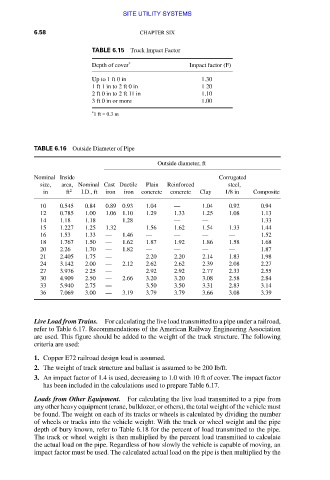
                                     TABLE 6.15  Truck Impact Factor

                                     Depth of cover *         Impact factor (F)
                                     Up to 1 ft 0 in              1.30
                                     1 ft 1 in to 2 ft 0 in       1 20
                                     2 ft 0 in to 2 ft 11 in       1.10
                                     3 ft 0 in or more            1.00

                                     *
                                     1 ft = 0.3 m


                      TABLE 6.16  Outside Diameter of Pipe

                                                                         Outside diameter, ft
                      Nominal   Inside                                Corrugated
                          size,    area,   Nominal  Cast  Ductile     Plain   Reinforced           steel,
                               2
                            in       ft     I.D., ft   iron     iron   concrete    concrete   Clay      1/8 in   Composite
                       10   0.545   0.84   0.89 0.93   1.04   —   1.04   0.92    0.94
                       12   0.785   1.00   1.06 1.10   1.29   1.33   1.25   1.08   1.13
                       14   1.18   1.18      1.28         —       —              1.33
                       15   1.227   1.25   1.32    1.56   1.62    1.54   1.33    1.44
                       16   1.53   1.33  —   1.46  —      —       —      —       1.52
                       18   1.767  1.50  —   1.62  1.87   1.92    1.86   1.58    1.68
                       20   2.26   1.70  —   1.82  —      —       —      —       1.87
                       21   2.405  1.75  —         2.20   2.20    2.14   1.83    1.98
                       24   3.142  2.00  —   2.12  2.62   2.62    2.39   2.08    2.27
                       27   3.976  2 25  —         2.92   2.92    2.77   2.33    2.55
                       30   4.909  2.50  —   2.66  3.20   3.20    3.08   2.58    2.84
                       33   5.940  2.75  —         3.50   3.50    3.31   2.83    3.14
                       36   7.069  3.00  —   3.19  3.79   3.79    3.66   3.08    3.39


                      Live Load from Trains.  For calculating the live load transmitted to a pipe under a railroad,
                      refer to Table 6.17. Recommendations of the American Railway Engineering Association
                      are used. This figure should be added to the weight of the track structure. The following
                      criteria are used:

                      1.  Copper E72 railroad design load is assumed.
                      2.  The weight of track structure and ballast is assumed to be 200 lb/ft.
                      3.  An impact factor of 1.4 is used, decreasing to 1.0 with 10 ft of cover. The impact factor
                        has been included in the calculations used to prepare Table 6.17.
                      Loads from Other Equipment.  For calculating the live load transmitted to a pipe from
                      any other heavy equipment (crane, bulldozer, or others), the total weight of the vehicle must
                      be found. The weight on each of its tracks or wheels is calculated by dividing the number
                      of wheels or tracks into the vehicle weight. With the track or wheel weight and the pipe
                      depth of bury known, refer to Table 6.18 for the percent of load transmitted to the pipe.
                      The track or wheel weight is then multiplied by the percent load transmitted to calculate
                      the actual load on the pipe. Regardless of how slowly the vehicle is capable of moving, an
                      impact factor must be used. The calculated actual load on the pipe is then multiplied by the


                   Downloaded from Digital Engineering Library @ McGraw-Hill (www.accessengineeringlibrary.com)
                              Copyright © 2009 The McGraw-Hill Companies. All rights reserved.
                                Any use is subject to the Terms of Use as given at the website.

