


Page 491 - Fair, Geyer, and Okun's Water and wastewater engineering : water supply and wastewater removal
P. 491
JWCL344_ch12_398-456.qxd  8/4/10  9:37 PM  Page 449


                                                                           12.7 Selection of Best Management Practices  449
                                         example of this methodology where the cost effectiveness drops dramatically as practices
                                         are implemented to reduce lake standards exceedances to below 10 days per year.
                                             The cost/benefit ratio approach, however, is limited by the number of cost/benefit
                                         ratios that can be conveniently considered simultaneously. To represent the different ele-
                                         ments of a complex issue better, where some benefits might be counterbalanced by some
                                         detriments, multiple costs and benefits must be considered.

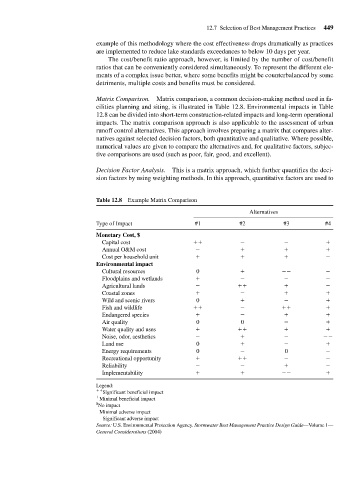
                                         Matrix Comparison.  Matrix comparison, a common decision-making method used in fa-
                                         cilities planning and siting, is illustrated in Table 12.8. Environmental impacts in Table
                                         12.8 can be divided into short-term construction-related impacts and long-term operational
                                         impacts. The matrix comparison approach is also applicable to the assessment of urban
                                         runoff control alternatives. This approach involves preparing a matrix that compares alter-
                                         natives against selected decision factors, both quantitative and qualitative. Where possible,
                                         numerical values are given to compare the alternatives and, for qualitative factors, subjec-
                                         tive comparisons are used (such as poor, fair, good, and excellent).
                                         Decision Factor Analysis.  This is a matrix approach, which further quantifies the deci-
                                         sion factors by using weighting methods. In this approach, quantitative factors are used to


                                         Table 12.8  Example Matrix Comparison
                                                                                        Alternatives

                                         Type of Impact                #1            #2           #3           #4
                                         Monetary Cost, $
                                           Capital cost
                                           Annual O&M cost
                                           Cost per household unit
                                         Environmental impact
                                           Cultural resources           0
                                           Floodplains and wetlands
                                           Agricultural lands
                                           Coastal zones
                                           Wild and scenic rivers       0
                                           Fish and wildlife
                                           Endangered species
                                           Air quality                  0            0
                                           Water quality and uses
                                           Noise, odor, aesthetics
                                           Land use                     0
                                           Energy requirements          0                          0
                                           Recreational opportunity
                                           Reliability
                                           Implementability

                                         Legend:

                                           Significant beneficial impact

                                          Minimal beneficial impact
                                         0
                                          No impact

                                          Minimal adverse impact

                                           Significant adverse impact
                                         Source: U.S. Environmental Protection Agency. Stormwater Best Management Practice Design Guide—Volume 1—
                                         General Considerations (2004)

