


Page 569 - Fair, Geyer, and Okun's Water and wastewater engineering : water supply and wastewater removal
P. 569
JWCL344_ch14_500-554.qxd  8/7/10  8:56 PM  Page 526


                    526  Chapter 14  Design of Sewer Systems

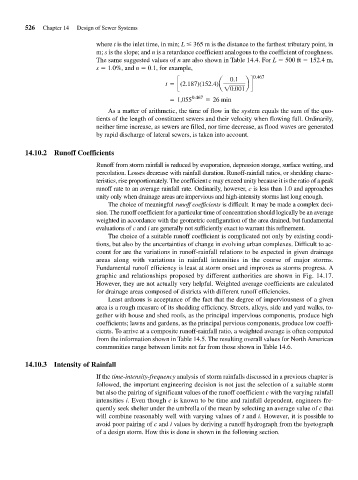
                                         where t is the inlet time, in min; L   365 m is the distance to the farthest tributary point, in
                                         m; s is the slope; and n is a retardance coefficient analogous to the coefficient of roughness.
                                         The same suggested values of n are also shown in Table 14.4. For L   500 ft   152.4 m,
                                         s   1.0%, and n   0.1, for example,
                                                                                  0.1    0.467
                                                                t = c(2.187)(152.4)a   bd
                                                                                10.001
                                                                 = 1,055 0.467  = 26 min
                                             As a matter of arithmetic, the time of flow in the system equals the sum of the quo-
                                         tients of the length of constituent sewers and their velocity when flowing full. Ordinarily,
                                         neither time increase, as sewers are filled, nor time decrease, as flood waves are generated
                                         by rapid discharge of lateral sewers, is taken into account.

                    14.10.2  Runoff Coefficients

                                         Runoff from storm rainfall is reduced by evaporation, depression storage, surface wetting, and
                                         percolation. Losses decrease with rainfall duration. Runoff-rainfall ratios, or shedding charac-
                                         teristics, rise proportionately. The coefficient c may exceed unity because it is the ratio of a peak
                                         runoff rate to an average rainfall rate. Ordinarily, however, c is less than 1.0 and approaches
                                          unity only when drainage areas are impervious and high-intensity storms last long enough.
                                             The choice of meaningful runoff coefficients is difficult. It may be made a complex deci-
                                          sion. The runoff coefficient for a particular time of concentration should logically be an average
                                          weighted in accordance with the geometric configuration of the area drained, but fundamental
                                          evaluations of c and i are generally not sufficiently exact to warrant this refinement.
                                             The choice of a suitable runoff coefficient is complicated not only by existing condi-
                                          tions, but also by the uncertainties of change in evolving urban complexes. Difficult to ac-
                                          count for are the variations in runoff-rainfall relations to be expected in given drainage
                                          areas along with variations in rainfall intensities in the course of major storms.
                                          Fundamental runoff efficiency is least at storm onset and improves as storms progress. A
                                          graphic and relationships proposed by different authorities are shown in Fig. 14.17.
                                          However, they are not actually very helpful. Weighted average coefficients are calculated
                                          for drainage areas composed of districts with different runoff efficiencies.
                                             Least arduous is acceptance of the fact that the degree of imperviousness of a given
                                          area is a rough measure of its shedding efficiency. Streets, alleys, side and yard walks, to-
                                          gether with house and shed roofs, as the principal impervious components, produce high
                                          coefficients; lawns and gardens, as the principal pervious components, produce low coeffi-
                                          cients. To arrive at a composite runoff-rainfall ratio, a weighted average is often computed
                                          from the information shown in Table 14.5. The resulting overall values for North American
                                          communities range between limits not far from those shown in Table 14.6.

                    14.10.3  Intensity of Rainfall

                                         If the time-intensity-frequency analysis of storm rainfalls discussed in a previous chapter is
                                         followed, the important engineering decision is not just the selection of a suitable storm
                                         but also the pairing of significant values of the runoff coefficient c with the varying rainfall
                                         intensities i. Even though c is known to be time and rainfall dependent, engineers fre-
                                         quently seek shelter under the umbrella of the mean by selecting an average value of c that
                                         will combine reasonably well with varying values of t and i. However, it is possible to
                                         avoid poor pairing of c and i values by deriving a runoff hydrograph from the hyetograph
                                         of a design storm. How this is done is shown in the following section.

