


Page 568 - Fair, Geyer, and Okun's Water and wastewater engineering : water supply and wastewater removal
P. 568
JWCL344_ch14_500-554.qxd  8/7/10  8:56 PM  Page 525


                                                                             14.10 Capacity Design in Storm Drainage  525
                    14.10.1  Time of Concentration

                                         The time of concentration is composed of two parts: (a) the inlet time, or time required for
                                         runoff to gain entrance to a sewer, and (b) the time of flow in the sewerage system.
                                             The inlet time is a function of:
                                             1. Surface roughness offering resistance to flow
                                             2. Depression storage delaying runoff and often reducing its total
                                             3. Steepness of areal slope, governing speed of overland flow
                                             4. Size of block or distance from the areal divide to the sewer inlet determining time
                                                of travel
                                             5. Degree of direct roof and surface drainage reducing losses and shortening inlet times
                                             6. Spacing of street inlets affecting elapsed times of flow.
                                             In large communities, in which roofs shed water directly to sewers, and runoff from
                                         paved yards and streets enters the drainage system through closely spaced street inlets, the
                                         time of overland flow is usually less than 5 min. In districts with relatively flat slopes and
                                         greater inlet spacing, the time may lengthen to 10 to 15 min.
                                             Except for rains of considerable duration, relatively little of the water entering inlets at the
                                         time of peak flow originates from unpaved areas. Therefore, the time between the peak rainfall
                                         rate and the peak flow at an inlet is often less than 1 min. Applying short inlet times and associ-
                                         ated high intensities to paved areas only will sometimes produce the best estimates of inlet flows.
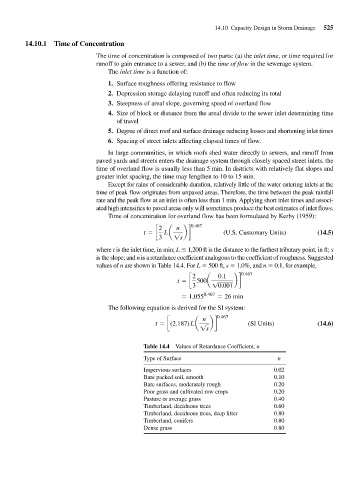
                                             Time of concentration for overland flow has been formulated by Kerby (1959):

                                                            2     n   0.467
                                                        t = c    L a  bd        (U.S. Customary Units)       (14.5)
                                                            3    1s
                                         where t is the inlet time, in min; L   1,200 ft is the distance to the farthest tributary point, in ft; s
                                         is the slope; and n is a retardance coefficient analogous to the coefficient of roughness. Suggested
                                         values of n are shown in Table 14.4. For L   500 ft, s   1.0%, and n   0.1, for example,
                                                                       2       0.1    0.467
                                                                    t = c   500a   bd
                                                                       3     10.001
                                                                     = 1,055 0.467  = 26 min

                                             The following equation is derived for the SI system:
                                                                          n   0.467
                                                           t = c(2.187) L a  bd         (SI Units)           (14.6)
                                                                         1s

                                                        Table 14.4 Values of Retardance Coefficient, n
                                                        Type of Surface                          n
                                                        Impervious surfaces                    0.02
                                                        Bare packed soil, smooth               0.10
                                                        Bare surfaces, moderately rough        0.20
                                                        Poor grass and cultivated row crops    0.20
                                                        Pasture or average grass               0.40
                                                        Timberland, deciduous trees            0.60
                                                        Timberland, deciduous trees, deep litter  0.80
                                                        Timberland, conifers                   0.80
                                                        Dense grass                            0.80

