


Page 222 - Flexible Robotics in Medicine
P. 222
Compliant bending tubular mechanisms with variable groove patterns 209


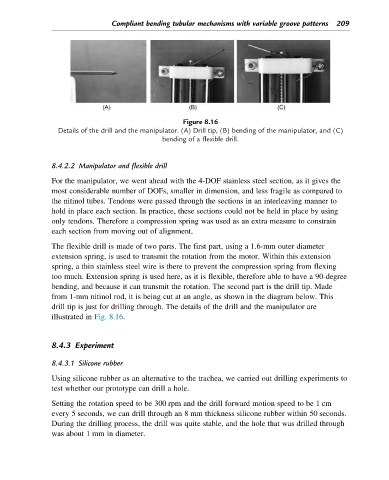
                                                    Figure 8.16
                 Details of the drill and the manipulator. (A) Drill tip, (B) bending of the manipulator, and (C)
                                              bending of a flexible drill.


               8.4.2.2 Manipulator and flexible drill

               For the manipulator, we went ahead with the 4-DOF stainless steel section, as it gives the
               most considerable number of DOFs, smaller in dimension, and less fragile as compared to
               the nitinol tubes. Tendons were passed through the sections in an interleaving manner to
               hold in place each section. In practice, these sections could not be held in place by using
               only tendons. Therefore a compression spring was used as an extra measure to constrain
               each section from moving out of alignment.
               The flexible drill is made of two parts. The first part, using a 1.6-mm outer diameter
               extension spring, is used to transmit the rotation from the motor. Within this extension
               spring, a thin stainless steel wire is there to prevent the compression spring from flexing
               too much. Extension spring is used here, as it is flexible, therefore able to have a 90-degree
               bending, and because it can transmit the rotation. The second part is the drill tip. Made
               from 1-mm nitinol rod, it is being cut at an angle, as shown in the diagram below. This
               drill tip is just for drilling through. The details of the drill and the manipulator are
               illustrated in Fig. 8.16.


               8.4.3 Experiment

               8.4.3.1 Silicone rubber

               Using silicone rubber as an alternative to the trachea, we carried out drilling experiments to
               test whether our prototype can drill a hole.
               Setting the rotation speed to be 300 rpm and the drill forward motion speed to be 1 cm
               every 5 seconds, we can drill through an 8 mm thickness silicone rubber within 50 seconds.
               During the drilling process, the drill was quite stable, and the hole that was drilled through
               was about 1 mm in diameter.

