


Page 465 - Flexible Robotics in Medicine
P. 465
Thermo-responsive hydrogel-based circular valve  459


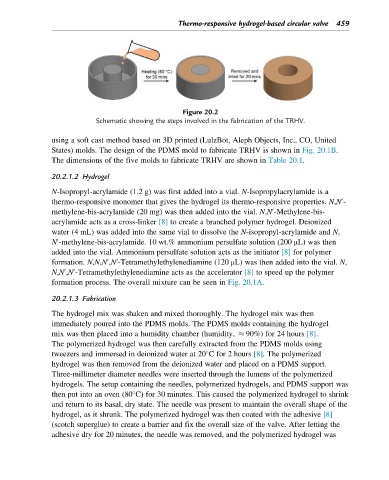
                                                    Figure 20.2
                            Schematic showing the steps involved in the fabrication of the TRHV.


               using a soft cast method based on 3D printed (LulzBot, Aleph Objects, Inc., CO, United
               States) molds. The design of the PDMS mold to fabricate TRHV is shown in Fig. 20.1B.
               The dimensions of the five molds to fabricate TRHV are shown in Table 20.1.

               20.2.1.2 Hydrogel

               N-Isopropyl-acrylamide (1.2 g) was first added into a vial. N-Isopropylacrylamide is a
               thermo-responsive monomer that gives the hydrogel its thermo-responsive properties. N,N -
                                                                                                0
                                                                            0
               methylene-bis-acrylamide (20 mg) was then added into the vial. N,N -Methylene-bis-
               acrylamide acts as a cross-linker [8] to create a branched polymer hydrogel. Deionized
               water (4 mL) was added into the same vial to dissolve the N-isopropyl-acrylamide and N,
               N -methylene-bis-acrylamide. 10 wt.% ammonium persulfate solution (200 µL) was then
                 0
               added into the vial. Ammonium persulfate solution acts as the initiator [8] for polymer
                                 0
                               0
               formation. N,N,N ,N -Tetramethylethylenediamine (120 µL) was then added into the vial. N,
               N,N ,N -Tetramethylethylenediamine acts as the accelerator [8] to speed up the polymer
                     0
                   0
               formation process. The overall mixture can be seen in Fig. 20.1A.
               20.2.1.3 Fabrication
               The hydrogel mix was shaken and mixed thoroughly. The hydrogel mix was then
               immediately poured into the PDMS molds. The PDMS molds containing the hydrogel
               mix was then placed into a humidity chamber (humidity,   90%) for 24 hours [8].
               The polymerized hydrogel was then carefully extracted from the PDMS molds using

               tweezers and immersed in deionized water at 20 C for 2 hours [8]. The polymerized
               hydrogel was then removed from the deionized water and placed on a PDMS support.
               Three-millimeter diameter needles were inserted through the lumens of the polymerized
               hydrogels. The setup containing the needles, polymerized hydrogels, and PDMS support was
               then put into an oven (80 C) for 30 minutes. This caused the polymerized hydrogel to shrink

               and return to its basal, dry state. The needle was present to maintain the overall shape of the
               hydrogel, as it shrunk. The polymerized hydrogel was then coated with the adhesive [8]
               (scotch superglue) to create a barrier and fix the overall size of the valve. After letting the
               adhesive dry for 20 minutes, the needle was removed, and the polymerized hydrogel was

