


Page 466 - Flexible Robotics in Medicine
P. 466
460 Chapter 20


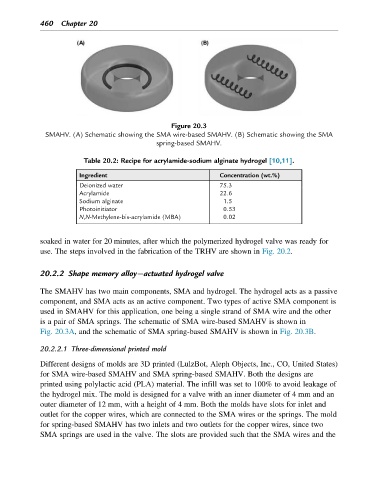
                                                Figure 20.3
              SMAHV. (A) Schematic showing the SMA wire-based SMAHV. (B) Schematic showing the SMA
                                            spring-based SMAHV.

                        Table 20.2: Recipe for acrylamide-sodium alginate hydrogel [10,11].

                       Ingredient                             Concentration (wt.%)
                       Deionized water                        75.3
                       Acrylamide                             22.6
                       Sodium alginate                         1.5
                       Photoinitiator                          0.53
                       N,N-Methylene-bis-acrylamide (MBA)      0.02


            soaked in water for 20 minutes, after which the polymerized hydrogel valve was ready for
            use. The steps involved in the fabrication of the TRHV are shown in Fig. 20.2.


            20.2.2 Shape memory alloy actuated hydrogel valve

            The SMAHV has two main components, SMA and hydrogel. The hydrogel acts as a passive
            component, and SMA acts as an active component. Two types of active SMA component is
            used in SMAHV for this application, one being a single strand of SMA wire and the other
            is a pair of SMA springs. The schematic of SMA wire-based SMAHV is shown in
            Fig. 20.3A, and the schematic of SMA spring-based SMAHV is shown in Fig. 20.3B.

            20.2.2.1 Three-dimensional printed mold
            Different designs of molds are 3D printed (LulzBot, Aleph Objects, Inc., CO, United States)
            for SMA wire-based SMAHV and SMA spring-based SMAHV. Both the designs are
            printed using polylactic acid (PLA) material. The infill was set to 100% to avoid leakage of
            the hydrogel mix. The mold is designed for a valve with an inner diameter of 4 mm and an
            outer diameter of 12 mm, with a height of 4 mm. Both the molds have slots for inlet and
            outlet for the copper wires, which are connected to the SMA wires or the springs. The mold
            for spring-based SMAHV has two inlets and two outlets for the copper wires, since two
            SMA springs are used in the valve. The slots are provided such that the SMA wires and the

