


Page 471 - Flexible Robotics in Medicine
P. 471
Thermo-responsive hydrogel-based circular valve  465


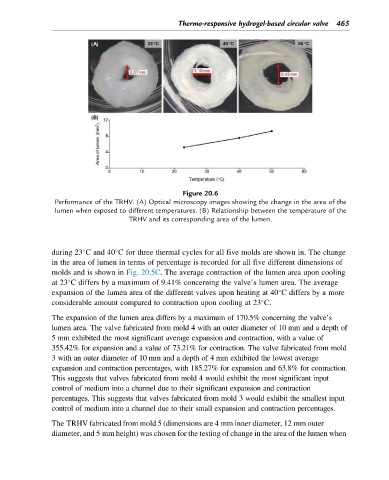
                                                    Figure 20.6
                Performance of the TRHV. (A) Optical microscopy images showing the change in the area of the
                lumen when exposed to different temperatures. (B) Relationship between the temperature of the
                                     TRHV and its corresponding area of the lumen.


               during 23 C and 40 C for three thermal cycles for all five molds are shown in. The change


               in the area of lumen in terms of percentage is recorded for all five different dimensions of
               molds and is shown in Fig. 20.5C. The average contraction of the lumen area upon cooling

               at 23 C differs by a maximum of 9.41% concerning the valve’s lumen area. The average
               expansion of the lumen area of the different valves upon heating at 40 C differs by a more

               considerable amount compared to contraction upon cooling at 23 C.

               The expansion of the lumen area differs by a maximum of 170.5% concerning the valve’s
               lumen area. The valve fabricated from mold 4 with an outer diameter of 10 mm and a depth of
               5 mm exhibited the most significant average expansion and contraction, with a value of
               355.42% for expansion and a value of 73.21% for contraction. The valve fabricated from mold
               3 with an outer diameter of 10 mm and a depth of 4 mm exhibited the lowest average
               expansion and contraction percentages, with 185.27% for expansion and 63.8% for contraction.
               This suggests that valves fabricated from mold 4 would exhibit the most significant input
               control of medium into a channel due to their significant expansion and contraction
               percentages. This suggests that valves fabricated from mold 3 would exhibit the smallest input
               control of medium into a channel due to their small expansion and contraction percentages.

               The TRHV fabricated from mold 5 (dimensions are 4 mm inner diameter, 12 mm outer
               diameter, and 5 mm height) was chosen for the testing of change in the area of the lumen when

