


Page 472 - Flexible Robotics in Medicine
P. 472
466 Chapter 20


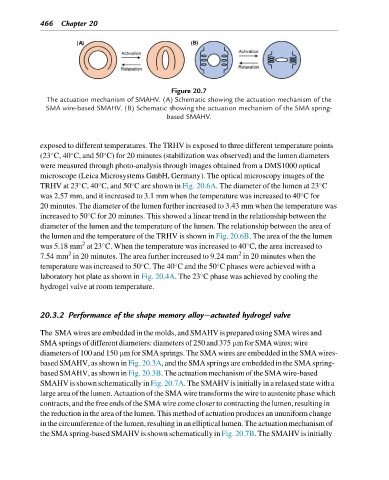
                                                Figure 20.7
              The actuation mechanism of SMAHV. (A) Schematic showing the actuation mechanism of the
              SMA wire-based SMAHV. (B) Schematic showing the actuation mechanism of the SMA spring-
                                               based SMAHV.


            exposed to different temperatures. The TRHV is exposed to three different temperature points
            (23 C, 40 C, and 50 C) for 20 minutes (stabilization was observed) and the lumen diameters


            were measured through photo-analysis through images obtained from a DMS1000 optical
            microscope (Leica Microsystems GmbH, Germany). The optical microscopy images of the
            TRHV at 23 C, 40 C, and 50 C are shown in Fig. 20.6A. The diameter of the lumen at 23 C


            was 2.57 mm, and it increased to 3.1 mm when the temperature was increased to 40 C for
            20 minutes. The diameter of the lumen further increased to 3.43 mm when the temperature was
            increased to 50 C for 20 minutes. This showed a linear trend in the relationship between the

            diameter of the lumen and the temperature of the lumen. The relationship between the area of
            the lumen and the temperature of the TRHV is shown in Fig. 20.6B. The area of the the lumen
                        2
            was 5.18 mm at 23 C. When the temperature was increased to 40 C, the area increased to


                    2
                                                                   2
            7.54 mm in 20 minutes. The area further increased to 9.24 mm in 20 minutes when the


            temperature was increased to 50 C. The 40 C and the 50 C phases were achieved with a

            laboratory hot plate as shown in Fig. 20.4A. The 23 C phase was achieved by cooling the

            hydrogel valve at room temperature.
            20.3.2 Performance of the shape memory alloy actuated hydrogel valve
            The SMA wires are embedded in the molds, and SMAHV is prepared using SMA wires and
            SMA springs of different diameters: diameters of 250 and 375 µm for SMA wires; wire
            diameters of 100 and 150 µm for SMA springs. The SMA wires are embedded in the SMA wires-
            based SMAHV, as shown in Fig. 20.3A, and the SMA springs are embedded in the SMA spring-
            based SMAHV, as shown in Fig. 20.3B. The actuation mechanism of the SMA wire-based
            SMAHV is shown schematically in Fig. 20.7A. The SMAHV is initially in a relaxed state with a
            large area of the lumen. Actuation of the SMA wire transforms the wire to austenite phase which
            contracts, and the free ends of the SMA wire come closer to contracting the lumen, resulting in
            the reduction in the area of the lumen. This method of actuation produces an ununiform change
            in the circumference of the lumen, resulting in an elliptical lumen. The actuation mechanism of
            the SMA spring-based SMAHV is shown schematically in Fig. 20.7B. The SMAHV is initially

