


Page 476 - Flexible Robotics in Medicine
P. 476
470 Chapter 20
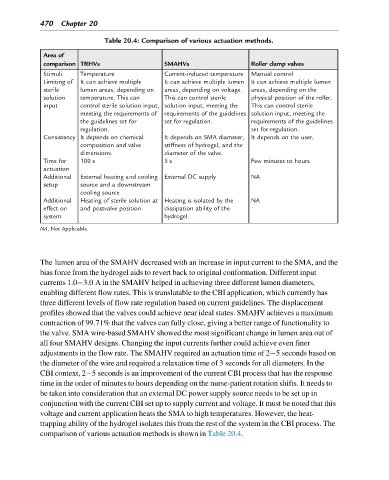
                              Table 20.4: Comparison of various actuation methods.

             Area of
             comparison TRHVs                  SMAHVs                  Roller clamp valves
             Stimuli   Temperature             Current-induced temperature  Manual control
             Limiting of  It can achieve multiple  It can achieve multiple lumen  It can achieve multiple lumen
             sterile   lumen areas, depending on  areas, depending on voltage.  areas, depending on the
             solution  temperature. This can   This can control sterile  physical position of the roller.
             input     control sterile solution input, solution input, meeting the  This can control sterile
                       meeting the requirements of  requirements of the guidelines solution input, meeting the
                       the guidelines set for  set for regulation.     requirements of the guidelines
                       regulation.                                     set for regulation.
             Consistency It depends on chemical  It depends on SMA diameter,  It depends on the user.
                       composition and valve   stiffness of hydrogel, and the
                       dimensions.             diameter of the valve.
             Time for  100 s                   5 s                     Few minutes to hours
             actuation
             Additional  External heating and cooling  External DC supply  NA
             setup     source and a downstream
                       cooling source
             Additional  Heating of sterile solution at  Heating is isolated by the  NA
             effect on  and postvalve position  dissipation ability of the
             system                            hydrogel.
            NA, Not Applicable.


            The lumen area of the SMAHV decreased with an increase in input current to the SMA, and the
            bias force from the hydrogel aids to revert back to original conformation. Different input
            currents 1.0 3.0 A in the SMAHV helped in achieving three different lumen diameters,
            enabling different flow rates. This is translatable to the CBI application, which currently has
            three different levels of flow rate regulation based on current guidelines. The displacement
            profiles showed that the valves could achieve near ideal states. SMAHV achieves a maximum
            contraction of 99.71% that the valves can fully close, giving a better range of functionality to
            the valve. SMA wire-based SMAHV showed the most significant change in lumen area out of
            all four SMAHV designs. Changing the input currents further could achieve even finer
            adjustments in the flow rate. The SMAHV required an actuation time of 2 5 seconds based on
            the diameter of the wire and required a relaxation time of 3 seconds for all diameters. In the
            CBI context, 2 5 seconds is an improvement of the current CBI process that has the response
            time in the order of minutes to hours depending on the nurse-patient rotation shifts. It needs to
            be taken into consideration that an external DC power supply source needs to be set up in
            conjunction with the current CBI set up to supply current and voltage. It must be noted that this
            voltage and current application heats the SMA to high temperatures. However, the heat-
            trapping ability of the hydrogel isolates this from the rest of the system in the CBI process. The
            comparison of various actuation methods is shown in Table 20.4.

