


Page 473 - Flexible Robotics in Medicine
P. 473
Thermo-responsive hydrogel-based circular valve  467


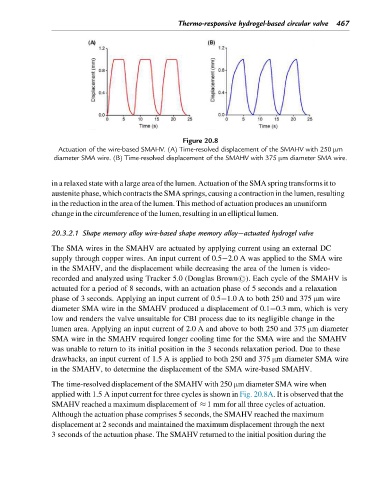
                                                    Figure 20.8
                 Actuation of the wire-based SMAHV. (A) Time-resolved displacement of the SMAHV with 250 µm
                diameter SMA wire. (B) Time-resolved displacement of the SMAHV with 375 µm diameter SMA wire.


               in a relaxed state with a large area of the lumen. Actuation of the SMA spring transforms it to
               austenite phase, which contracts the SMA springs, causing a contraction in the lumen, resulting
               in the reduction in the area of the lumen. This method of actuation produces an ununiform
               change in the circumference of the lumen, resulting in an elliptical lumen.


               20.3.2.1 Shape memory alloy wire-based shape memory alloy actuated hydrogel valve
               The SMA wires in the SMAHV are actuated by applying current using an external DC
               supply through copper wires. An input current of 0.5 2.0 A was applied to the SMA wire
               in the SMAHV, and the displacement while decreasing the area of the lumen is video-
               recorded and analyzed using Tracker 5.0 (Douglas Brownr). Each cycle of the SMAHV is
               actuated for a period of 8 seconds, with an actuation phase of 5 seconds and a relaxation
               phase of 3 seconds. Applying an input current of 0.5 1.0 A to both 250 and 375 µm wire
               diameter SMA wire in the SMAHV produced a displacement of 0.1 0.3 mm, which is very
               low and renders the valve unsuitable for CBI process due to its negligible change in the
               lumen area. Applying an input current of 2.0 A and above to both 250 and 375 µm diameter
               SMA wire in the SMAHV required longer cooling time for the SMA wire and the SMAHV
               was unable to return to its initial position in the 3 seconds relaxation period. Due to these
               drawbacks, an input current of 1.5 A is applied to both 250 and 375 µm diameter SMA wire
               in the SMAHV, to determine the displacement of the SMA wire-based SMAHV.

               The time-resolved displacement of the SMAHV with 250 µm diameter SMA wire when
               applied with 1.5 A input current for three cycles is shown in Fig. 20.8A. It is observed that the
               SMAHV reached a maximum displacement of   1 mm for all three cycles of actuation.
               Although the actuation phase comprises 5 seconds, the SMAHV reached the maximum
               displacement at 2 seconds and maintained the maximum displacement through the next
               3 seconds of the actuation phase. The SMAHV returned to the initial position during the

