


Page 190 - Fluid Mechanics and Thermodynamics of Turbomachinery
P. 190
Three-dimensional Flows in Axial Turbomachines 171
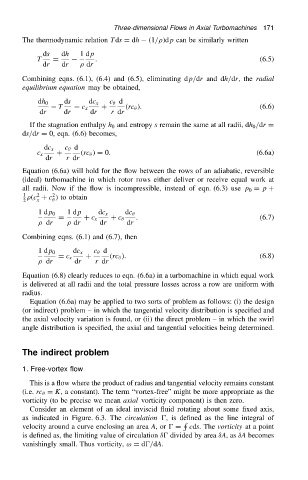
The thermodynamic relation Tds D dh .1/ /dp can be similarly written
ds dh 1 dp
T D . (6.5)
dr dr dr
Combining eqns. (6.1), (6.4) and (6.5), eliminating dp/dr and dh/dr, the radial
equilibrium equation may be obtained,
ds c d
dh 0 dc x
T D c x C .rc /. (6.6)
dr dr dr r dr
If the stagnation enthalpy h 0 and entropy s remain the same at all radii, dh 0 /dr D
ds/dr D 0, eqn. (6.6) becomes,
dc x c d
c x C .rc / D 0. (6.6a)
dr r dr
Equation (6.6a) will hold for the flow between the rows of an adiabatic, reversible
(ideal) turbomachine in which rotor rows either deliver or receive equal work at
all radii. Now if the flow is incompressible, instead of eqn. (6.3) use p 0 D p C
2
2
1 .c C c / to obtain
2 x
1 dp
1 dp 0 dc x dc
D C c x C c . (6.7)
dr dr dr dr
Combining eqns. (6.1) and (6.7), then
1 dp 0 dc x c d
D c x C .rc /. (6.8)
dr dr r dr
Equation (6.8) clearly reduces to eqn. (6.6a) in a turbomachine in which equal work
is delivered at all radii and the total pressure losses across a row are uniform with
radius.
Equation (6.6a) may be applied to two sorts of problem as follows: (i) the design
(or indirect) problem in which the tangential velocity distribution is specified and
the axial velocity variation is found, or (ii) the direct problem in which the swirl
angle distribution is specified, the axial and tangential velocities being determined.
The indirect problem
1. Free-vortex flow
This is a flow where the product of radius and tangential velocity remains constant
(i.e. rc D K, a constant). The term “vortex-free” might be more appropriate as the
vorticity (to be precise we mean axial vorticity component) is then zero.
Consider an element of an ideal inviscid fluid rotating about some fixed axis,
as indicated in Figure. 6.3. The circulation , is defined as the line integral of
H
velocity around a curve enclosing an area A,or D cds. The vorticity at a point
is defined as, the limiting value of circulation υ divided by area υA,as υA becomes
vanishingly small. Thus vorticity, ω D d/dA.

