


Page 195 - Fluid Mechanics and Thermodynamics of Turbomachinery
P. 195
176 Fluid Mechanics, Thermodynamics of Turbomachinery
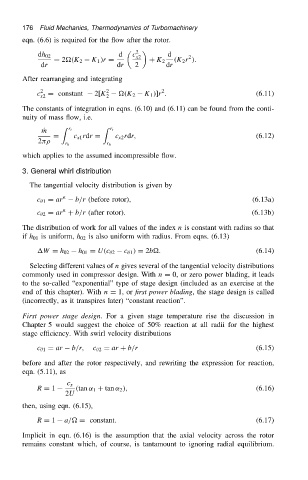
eqn. (6.6) is required for the flow after the rotor.
2
dh 02 d c x2 d 2
D 2.K 2 K 1 /r D C K 2 .K 2 r /.
dr dr 2 dr
After rearranging and integrating
2
c 2 x2 D constant 2[K 2 2 .K 2 K 1 /]r . (6.11)
The constants of integration in eqns. (6.10) and (6.11) can be found from the conti-
nuity of mass flow, i.e.
Z Z
P m r t r t
D c x1 rdr D c x2 rdr, (6.12)
2
r h r h
which applies to the assumed incompressible flow.
3. General whirl distribution
The tangential velocity distribution is given by
c 1 D ar n b/r (before rotor), .6.13a/
n
c 2 D ar C b/r (after rotor). .6.13b/
The distribution of work for all values of the index n is constant with radius so that
if h 01 is uniform, h 02 is also uniform with radius. From eqns. (6.13)
W D h 02 h 01 D U.c 2 c 1 / D 2b. (6.14)
Selecting different values of n gives several of the tangential velocity distributions
commonly used in compressor design. With n D 0, or zero power blading, it leads
to the so-called “exponential” type of stage design (included as an exercise at the
end of this chapter). With n D 1, or first power blading, the stage design is called
(incorrectly, as it transpires later) “constant reaction”.
First power stage design. For a given stage temperature rise the discussion in
Chapter 5 would suggest the choice of 50% reaction at all radii for the highest
stage efficiency. With swirl velocity distributions
c 1 D ar b/r, c 2 D ar C b/r (6.15)
before and after the rotor respectively, and rewriting the expression for reaction,
eqn. (5.11), as
c x
R D 1 .tan ˛ 1 C tan ˛ 2 /, (6.16)
2U
then, using eqn. (6.15),
R D 1 a/ D constant. (6.17)
Implicit in eqn. (6.16) is the assumption that the axial velocity across the rotor
remains constant which, of course, is tantamount to ignoring radial equilibrium.

