


Page 200 - Fluid Mechanics and Thermodynamics of Turbomachinery
P. 200
Three-dimensional Flows in Axial Turbomachines 181
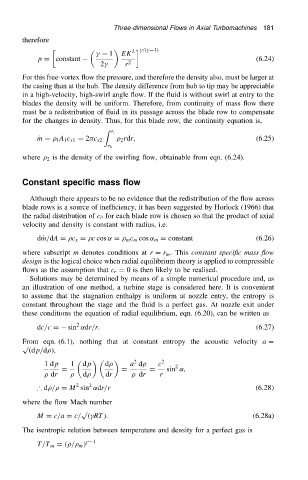
                          therefore
                                                        2
/.
 1/

   1  EK
                              p D constant                                                (6.24)
                                               2
     r 2
                          For this free-vortex flow the pressure, and therefore the density also, must be larger at
                          the casing than at the hub. The density difference from hub to tip may be appreciable
                          in a high-velocity, high-swirl angle flow. If the fluid is without swirl at entry to the
                          blades the density will be uniform. Therefore, from continuity of mass flow there
                          must be a redistribution of fluid in its passage across the blade row to compensate
                          for the changes in density. Thus, for this blade row, the continuity equation is,
                                                Z
                                                  r t
                                                      2 rdr,                              (6.25)
                              P m D   1 A 1 c x1 D 2 c x2
                                                 r h
                          where   2 is the density of the swirling flow, obtainable from eqn. (6.24).

                          Constant specific mass flow

                            Although there appears to be no evidence that the redistribution of the flow across
                          blade rows is a source of inefficiency, it has been suggested by Horlock (1966) that
                          the radial distribution of c   for each blade row is chosen so that the product of axial
                          velocity and density is constant with radius, i.e.
                              d Pm/dA D  c x D  c cos ˛ D   m c m cos ˛ m D constant      (6.26)

                          where subscript m denotes conditions at r D r m . This constant specific mass flow
                          design is the logical choice when radial equilibrium theory is applied to compressible
                          flows as the assumption that c r D 0 is then likely to be realised.
                            Solutions may be determined by means of a simple numerical procedure and, as
                          an illustration of one method, a turbine stage is considered here. It is convenient
                          to assume that the stagnation enthalpy is uniform at nozzle entry, the entropy is
                          constant throughout the stage and the fluid is a perfect gas. At nozzle exit under
                          these conditions the equation of radial equilibrium, eqn. (6.20), can be written as
                                         2
                              dc/c D sin ˛dr/r.                                           (6.27)
                          From eqn. (6.1), nothing that at constant entropy the acoustic velocity a D
                          p
                            .dp/d /,
                                                         2      2
                                1 dp   1   dp    d      a d    c    2
                                     D               D       D    sin ˛,
                                  dr       d     dr       dr    r
                                         2
                                            2
                              ∴ d /  D M sin ˛dr/r                                        .6.28/
                          where the flow Mach number
                                          p
                              M D c/a D c/ .
RT/.                                        (6.28a)
                          The isentropic relation between temperature and density for a perfect gas is

                              T/T m D . /  m /
 1

