Page 196 - Fluid Mechanics and Thermodynamics of Turbomachinery
P. 196
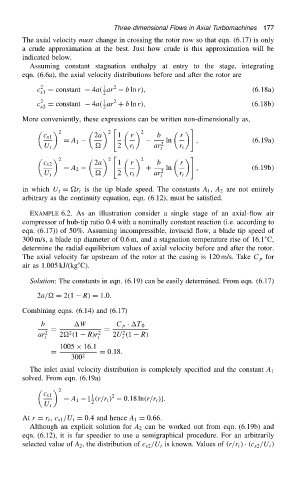
Three-dimensional Flows in Axial Turbomachines 177
                          The axial velocity must change in crossing the rotor row so that eqn. (6.17) is only
                          a crude approximation at the best. Just how crude is this approximation will be
                          indicated below.
                            Assuming constant stagnation enthalpy at entry to the stage, integrating
                          eqn. (6.6a), the axial velocity distributions before and after the rotor are
                                                1
                              c 2  D constant  4a. ar 2  b ln r/,                        .6.18a/
                               x1               2
                                                1
                                                   2
                              c 2  D constant  4a. ar C b ln r/,                         .6.18b/
                               x2               2
                          More conveniently, these expressions can be written non-dimensionally as,
                                                   "                    #

                                    2            2         2
                                c x1          2a    1   r      b     r
                                     D A 1                      2  ln     ,              .6.19a/
                                U t                2  r t    ar     r t
                                                                t
                                                   "                    #
                                    2             2        2
                                c x2          2a    1   r      b     r
                                     D A 2                  C   2  ln     ,              .6.19b/
                                U t                2  r t    ar t   r t
                          in which U t D r t is the tip blade speed. The constants A 1 , A 2 are not entirely
                          arbitrary as the continuity equation, eqn. (6.12), must be satisfied.
                            EXAMPLE 6.2. As an illustration consider a single stage of an axial-flow air
                          compressor of hub-tip ratio 0.4 with a nominally constant reaction (i.e. according to
                          eqn. (6.17)) of 50%. Assuming incompressible, inviscid flow, a blade tip speed of
                          300 m/s, a blade tip diameter of 0.6 m, and a stagnation temperature rise of 16.1 ° C,
                          determine the radial equilibrium values of axial velocity before and after the rotor.
                          The axial velocity far upstream of the rotor at the casing is 120 m/s. Take C p for
                          air as 1.005 kJ/(kg ° C).

                            Solution: The constants in eqn. (6.19) can be easily determined. From eqn. (6.17)
                              2a/ D 2.1   R/ D 1.0.

                          Combining eqns. (6.14) and (6.17)
                               b        W          C p Ð T 0
                                  D             D
                                       2
                                                     2
                              ar 2  2 .1   R/r 2  2U .1   R/
                                t              t     t
                                    1005 ð 16.1
                                  D            D 0.18.
                                       300 2
                            The inlet axial velocity distribution is completely specified and the constant A 1
                          solved. From eqn. (6.19a)
                                    2

                                c x1         1    2
                                     D A 1  [ .r/r t /  0.18 ln.r/r t /].
                                             2
                                U t
                          At r D r t , c x1 /U t D 0.4 and hence A 1 D 0.66.
                            Although an explicit solution for A 2 can be worked out from eqn. (6.19b) and
                          eqn. (6.12), it is far speedier to use a semigraphical procedure. For an arbitrarily
                          selected value of A 2 , the distribution of c x2 /U t is known. Values of .r/r t / Ð .c x2 /U t /
   191   192   193   194   195   196   197   198   199   200   201