


Page 197 - Fluid Mechanics and Thermodynamics of Turbomachinery
P. 197
178 Fluid Mechanics, Thermodynamics of Turbomachinery


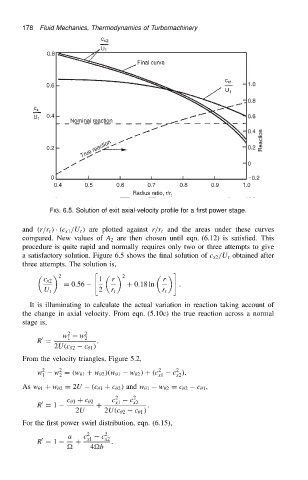
                                 FIG. 6.5. Solution of exit axial-velocity profile for a first power stage.


                          and .r/r t / Ð .c x1 /U t / are plotted against r/r t and the areas under these curves
                          compared. New values of A 2 are then chosen until eqn. (6.12) is satisfied. This
                          procedure is quite rapid and normally requires only two or three attempts to give
                          a satisfactory solution. Figure 6.5 shows the final solution of c x2 /U t obtained after
                          three attempts. The solution is,
                                              "                    #

                                    2                2
                                c x2           1   r             r
                                     D 0.56            C 0.18 ln     .
                                U t            2  r t           r t
                            It is illuminating to calculate the actual variation in reaction taking account of
                          the change in axial velocity. From eqn. (5.10c) the true reaction across a normal
                          stage is,
                                     w 1 2  w 2 2
                               0
                              R D             .
                                   2U.c  2  c  1 /
                          From the velocity triangles, Figure 5.2,
                                                                    2
                                    2
                              w 2  w D .w  1 C w  2 /.w  1  w  2 / C .c 2  c /.
                               1    2                          x1   x2
                          As w  1 C w  2 D 2U  .c  1 C c  2 / and w  1  w  2 D c  2  c  1 ,
                                                   c 2  c 2
                               0      c  1 C c  2  x1   x2
                              R D 1           C             .
                                         2U     2U.c  2  c  1 /
                          For the first power swirl distribution, eqn. (6.15),
                                      a    c 2 x1  c 2 x2
                               0
                              R D 1     C         .
                                            4b

