


Page 168 - Fluid Catalytic Cracking Handbook
P. 168
142   Fluid Catalytic Cracking Handbook

 cut points isolates the reactor system from the distillation sys-
 tem performance.
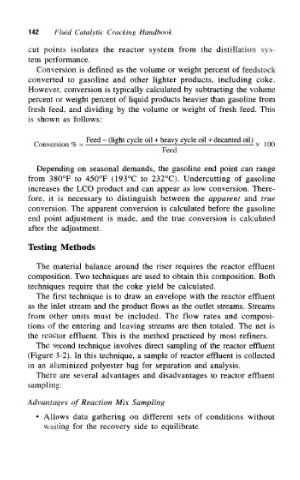
  Conversion is defined as the volume or weight percent of feedstock
 converted to gasoline and other lighter products, including coke.
 However, conversion is typically calculated by subtracting the volume
 percent or weight percent of liquid products heavier than gasoline from
 fresh feed, and dividing by the volume or weight of fresh feed. This
 is shown as follows:

  ~     ,  m   Feed - (light cycle oil + heavy cycle oil + decanted oil)  . ,,„
  Conversion % =     ^-^              —-                   x 100


  Depending on seasonal demands, the gasoline end point can range
 from 380°F to 450°F (193°C to 232°C). Undercutting of gasoline
 increases the LCO product and can appear as low conversion. There-
 fore, it is necessary to distinguish between the apparent and true
 conversion. The apparent conversion is calculated before the gasoline
 end point adjustment is made, and the true conversion is calculated
 after the adjustment.

 Testing Methods


  The material balance around the riser requires the reactor effluent
 composition. Two techniques are used to obtain this composition. Both
 techniques require that the coke yield be calculated.
  The first technique is to draw an envelope with the reactor effluent
 as the inlet stream and the product flows as the outlet streams. Streams
 from other units must be included. The flow rates and composi-
 tions of the entering and leaving streams are then totaled. The net is
 the reactor effluent. This is the method practiced by most refiners.
  The second technique involves direct sampling of the reactor effluent
 (Figure 5-2). In this technique, a sample of reactor effluent is collected
 in an aluminized polyester bag for separation and analysis.
  There are several advantages and disadvantages to reactor effluent
 sampling;

 Advantages of Reaction Mix Sampling
  • Allows data gathering on different sets of conditions without
    waiting for the recovery side to equilibrate.

