


Page 172 - Fluid Catalytic Cracking Handbook
P. 172
Unit Monitoring and Control  145

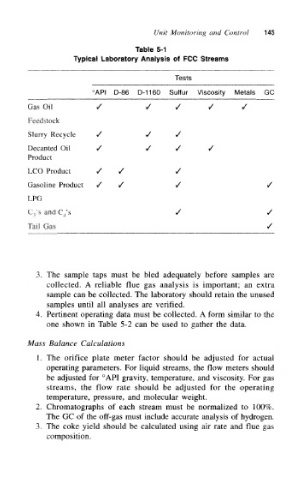
                             Table 5-1
            Typical Laboratory Analysis of FCC Streams

                                       Tests

                 °API D-86 D-1160     Sulfur  Viscosity  Metals  GC
 Gas Oil           /           /       /        /        /
 Feedstock

 Slurry Recycle   /             /       /
 Decanted Oil      /           /       /        /
 Product

 LCO Product      / /                   /
 Gasoline Product / /                  /                        /
 LPG
 C.,\s and C 4's                       /                        /

 Tail Gas                                                       /


   3. The sample taps must be bled adequately before samples are
     collected. A reliable flue gas analysis is important; an extra
     sample can be collected. The laboratory should retain the unused
     samples until all analyses are verified.
   4. Pertinent operating data must be collected. A form similar to the
     one shown in Table 5-2 can be used to gather the data.

 Mass Balance Calculations
   1. The orifice plate meter factor should be adjusted for actual
     operating parameters. For liquid streams, the flow meters should
     be adjusted for °API gravity, temperature, and viscosity. For gas
     streams, the flow rate should be adjusted for the operating
     temperature, pressure, and molecular weight.
   2. Chromatographs of each stream must be normalized to 100%.
     The GC of the off-gas must include accurate analysis of hydrogen,
   3. The coke yield should be calculated using air rate and flue gas
     composition.

