


Page 202 - Fluid Catalytic Cracking Handbook
P. 202
170  Fluid Catalytic Cracking Handbook

  • Regenerated catalyst slide (or plug) valve
  • Riser
  • Reactor-stripper
  • Spent catalyst standpipe
  • Spent catalyst slide (or plug) valve


 Regenerator Catalyst Hopper

  In some FCC units, the regenerated catalyst flows through a hopper
 prior to entering the standpipe. The hopper is usually internal to the
 regenerator and often of an inverted cone design. It provides sufficient
 time for the regenerated catalyst to be deaerated before entering the
 standpipe. This causes the catalyst entering the standpipe to have
 maximum flowing density. The higher the density, the greater the
 pressure buildup in the standpipe. In some FCC designs, the regenerated
 catalyst hopper is external with fluffing aeration to control the catalyst
 density entering the standpipe.


 Regenerated Catalyst Standpipe
  The standpipe's height provides the driving force for transferring
 the catalyst from the regenerator to the reactor. The elevation differ-
 ence between the standpipe entrance and the slide valve is the source
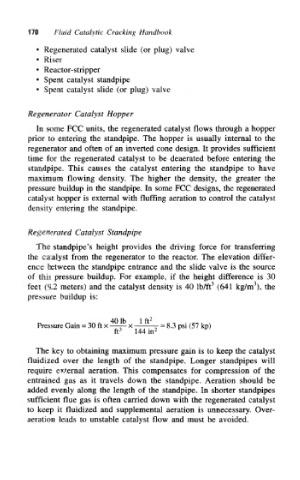
 of this pressure buildup. For example, if the height difference is 30
                                                           3
                                                3
 feet (9.2 meters) and the catalyst density is 40 lb/ft  (641 kg/m ), the
 pressure buildup is:

                     40 1h   1 ft 2
  Pressure Gain = 30 ft x -^ x   2 , = 8.3 psi (57 kp)
                       3
                                              F
                      ft    144 in
  The key to obtaining maximum pressure gain is to keep the catalyst
 fluidized over the length of the standpipe. Longer standpipes will
 require external aeration. This compensates for compression of the
 entrained gas as it travels down the standpipe. Aeration should be
 added evenly along the length of the standpipe. In shorter standpipes
 sufficient flue gas is often carried down with the regenerated catalyst
 to keep it fluidized and supplemental aeration is unnecessary. Over-
 aeration leads to unstable catalyst flow and must be avoided.

