


Page 319 - Fluid mechanics, heat transfer, and mass transfer
P. 319
SHELL AND TUBE HEAT EXCHANGERS
            300
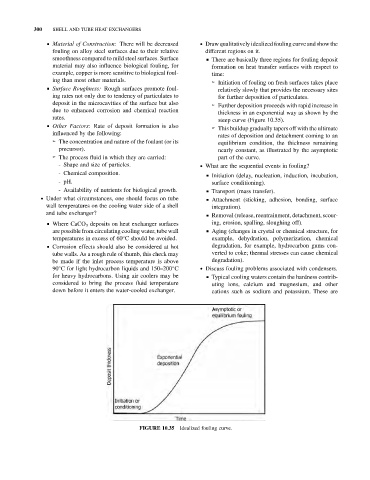
                 & Material of Construction: There will be decreased  . Draw qualitatively idealized fouling curve and show the
                  fouling on alloy steel surfaces due to their relative  different regions on it.
                  smoothness compared to mild steel surfaces. Surface  & There are basically three regions for fouling deposit
                  material may also influence biological fouling, for   formation on heat transfer surfaces with respect to
                  example, copper is more sensitive to biological foul-  time:
                  ing than most other materials.                       ➢ Initiation of fouling on fresh surfaces takes place
                 & Surface Roughness: Rough surfaces promote foul-
                                                                         relatively slowly that provides the necessary sites
                  ing rates not only due to tendency of particulates to  for further deposition of particulates.
                  deposit in the microcavities of the surface but also  ➢ Further deposition proceeds with rapid increase in
                  due to enhanced corrosion and chemical reaction
                                                                         thickness in an exponential way as shown by the
                  rates.
                                                                         steep curve (Figure 10.35).
                 & Other Factors: Rate of deposit formation is also
                                                                       ➢ This buildup gradually tapers off with the ultimate
                  influenced by the following:
                                                                         rates of deposition and detachment coming to an
                  ➢ The concentration and nature of the foulant (or its
                                                                         equilibrium condition, the thickness remaining
                    precursor).                                          nearly constant, as illustrated by the asymptotic
                  ➢ The process fluid in which they are carried:          part of the curve.
                    - Shape and size of particles.                 . What are the sequential events in fouling?
                    - Chemical composition.                          & Initiation (delay, nucleation, induction, incubation,
                    - pH.                                              surface conditioning).
                    - Availability of nutrients for biological growth.  & Transport (mass transfer).
               . Under what circumstances, one should focus on tube  & Attachment (sticking, adhesion, bonding, surface
                wall temperatures on the cooling water side of a shell  integration).
                and tube exchanger?                                  & Removal (release, reentrainment, detachment, scour-
                 & Where CaCO 3 deposits on heat exchanger surfaces    ing, erosion, spalling, sloughing off).
                  are possible from circulating cooling water, tube wall  & Aging (changes in crystal or chemical structure, for

                  temperatures in excess of 60 C should be avoided.    example, dehydration, polymerization, chemical
                 & Corrosion effects should also be considered at hot  degradation, for example, hydrocarbon gums con-
                  tube walls. As a rough rule of thumb, this check may  verted to coke; thermal stresses can cause chemical
                  be made if the inlet process temperature is above    degradation).
                  90 C for light hydrocarbon liquids and 150–200 C  . Discuss fouling problems associated with condensers.


                  for heavy hydrocarbons. Using air coolers may be   & Typical cooling waters contain the hardness contrib-
                  considered to bring the process fluid temperature     uting ions, calcium and magnesium, and other
                  down before it enters the water-cooled exchanger.    cations such as sodium and potassium. These are


                                               FIGURE 10.35 Idealized fouling curve.

