


Page 314 - Fluid mechanics, heat transfer, and mass transfer
P. 314
HEAT EXCHANGERS    295


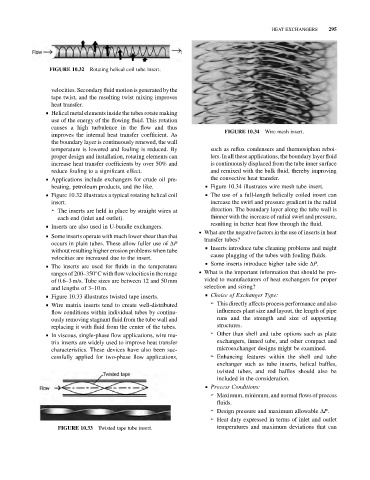
                 FIGURE 10.32 Rotating helical coil tube insert.


                  velocities. Secondary fluid motion is generated by the
                  tape twist, and the resulting twist mixing improves
                  heat transfer.
                & Helical metal elements inside the tubes rotate making
                  use of the energy of the flowing fluid. This rotation
                  causes a high turbulence in the flow and thus
                                                                           FIGURE 10.34 Wire mesh insert.
                  improves the internal heat transfer coefficient. As
                  the boundary layer is continuously renewed, the wall
                  temperature is lowered and fouling is reduced. By    such as reflux condensers and thermosiphon reboi-
                  proper design and installation, rotating elements can  lers. In all these applications, the boundary layer fluid
                  increase heat transfer coefficients by over 50% and   is continuously displaced from the tube inner surface
                  reduce fouling to a significant effect.               and remixed with the bulk fluid, thereby improving
                & Applications include exchangers for crude oil pre-   the convective heat transfer.
                  heating, petroleum products, and the like.         & Figure 10.34 illustrates wire mesh tube insert.
                & Figure 10.32 illustrates a typical rotating helical coil  & The use of a full-length helically coiled insert can
                  insert.                                              increase the swirl and pressure gradient in the radial
                  ➢ The inserts are held in place by straight wires at  direction. The boundary layer along the tube wall is
                    each end (inlet and outlet).                       thinner with the increase of radial swirl and pressure,
                                                                       resulting in better heat flow through the fluid.
                & Inserts are also used in U-bundle exchangers.
                                                                   . What are the negative factors in the use of inserts in heat
                & Some inserts operate with much lower shear than that
                                                                    transfer tubes?
                  occurs in plain tubes. These allow fuller use of DP
                                                                     & Inserts introduce tube cleaning problems and might
                  without resulting higher erosion problems when tube
                                                                       cause plugging of the tubes with fouling fluids.
                  velocities are increased due to the insert.
                                                                     & Some inserts introduce higher tube side DP.
                & The inserts are used for fluids in the temperature

                  ranges of 200–350 C with flow velocities in the range  . What is the important information that should be pro-
                  of 0.6–3 m/s. Tube sizes are between 12 and 50 mm  vided to manufacturers of heat exchangers for proper
                  and lengths of 3–10 m.                            selection and sizing?
                                                                     & Choice of Exchanger Type:
                & Figure 10.33 illustrates twisted tape inserts.
                                                                       ➢ This directly affects process performance and also
                & Wire matrix inserts tend to create well-distributed
                  flow conditions within individual tubes by continu-     influences plant size and layout, the length of pipe
                  ously removing stagnant fluid from the tube wall and    runs and the strength and size of supporting
                  replacing it with fluid from the center of the tubes.   structures.
                & In viscous, single-phase flow applications, wire ma-  ➢ Other than shell and tube options such as plate
                  trix inserts are widely used to improve heat transfer  exchangers, finned tube, and other compact and
                  characteristics. These devices have also been suc-     microexchanger designs might be examined.
                  cessfully applied for two-phase flow applications,    ➢ Enhancing features within the shell and tube
                                                                         exchanger such as tube inserts, helical baffles,
                                                                         twisted tubes, and rod baffles should also be
                                                                         included in the consideration.
                                                                     & Process Conditions:
                                                                       ➢ Maximum, minimum, and normal flows of process
                                                                         fluids.
                                                                       ➢ Design pressure and maximum allowable DP.
                                                                       ➢ Heat duty expressed in terms of inlet and outlet
                    FIGURE 10.33 Twisted tape tube insert.               temperatures and maximum deviations that can

