


Page 310 - Fluid mechanics, heat transfer, and mass transfer
P. 310
HEAT EXCHANGERS    291

                                                                   . What are the considerations involved in fixing baffle
                                                                    spacing?
                                                                     & Baffle spacing is the most vital parameter in shell and
                                                                       tube heat exchanger design.
                                                                     & The TEMA standards specify the minimum baffle
                                                                       spacing as one-fifth of the shell inside diameter or
                                                                       5 cm (2 in.), whichever is greater.
                                                                     & Closer spacing will result in poor bundle penetration
                                                                       by the shell side fluid and difficulty in mechanically
                                                                       cleaning the outside of the tubes.
                                                                     & Low baffle spacing results in a poor stream
                                                                       distribution.
                                                                     & The maximum baffle spacing is the shell inside
                                                                       diameter.
                                                                     & Higher baffle spacing will lead to predominantly
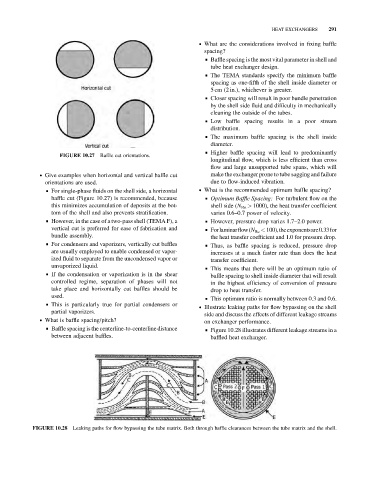
                     FIGURE 10.27 Baffle cut orientations.
                                                                       longitudinal flow, which is less efficient than cross
                                                                       flow and large unsupported tube spans, which will
              . Give examples when horizontal and vertical baffle cut   make the exchanger prone to tube sagging and failure
                orientations are used.                                 due to flow-induced vibration.
                & For single-phase fluids on the shell side, a horizontal  . What is the recommended optimum baffle spacing?
                  baffle cut (Figure 10.27) is recommended, because   & Optimum Baffle Spacing: For turbulent flow on the
                  this minimizes accumulation of deposits at the bot-  shell side (N Re > 1000), the heat transfer coefficient
                  tom of the shell and also prevents stratification.    varies 0.6–0.7 power of velocity.
                & However, in the case of a two-pass shell (TEMA F), a  & However, pressure drop varies 1.7–2.0 power.
                  vertical cut is preferred for ease of fabrication and  & Forlaminarflow(N Re < 100),theexponentsare0.33for
                  bundle assembly.                                     the heat transfer coefficient and 1.0 for pressure drop.
                & For condensers and vaporizers, vertically cut baffles  & Thus, as baffle spacing is reduced, pressure drop
                  are usually employed to enable condensed or vapor-   increases at a much faster rate than does the heat
                  ized fluid to separate from the uncondensed vapor or  transfer coefficient.
                  unvaporized liquid.                                & This means that there will be an optimum ratio of
                & If the condensation or vaporization is in the shear
                                                                       baffle spacing to shell inside diameter that will result
                  controlled regime, separation of phases will not     in the highest efficiency of conversion of pressure
                  take place and horizontally cut baffles should be     drop to heat transfer.
                  used.
                                                                     & This optimum ratio is normally between 0.3 and 0.6.
                & This is particularly true for partial condensers or
                                                                   . Illustrate leaking paths for flow bypassing on the shell
                  partial vaporizers.
                                                                    side and discuss the effects of different leakage streams
              . What is baffle spacing/pitch?
                                                                    on exchanger performance.
                & Baffle spacing is the centerline-to-centerline distance  & Figure 10.28 illustrates different leakage streams in a
                  between adjacent baffles.                             baffled heat exchanger.


                         Leaking paths for flow bypassing the tube matrix. Both through baffle clearances between the tube matrix and the shell.
            FIGURE 10.28

