


Page 313 - Fluid mechanics, heat transfer, and mass transfer
P. 313
SHELL AND TUBE HEAT EXCHANGERS
            294
                 & Direct impingement of fluid jet onto the tubes from  and alloys of nickel. Titanium or aluminum may also
                  inlet nozzle into the shell can cause cavitation,    be used for special purposes.
                  vibration, and erosion.                            & Table 10.5 gives briefly, material selection for cor-
                 & Impingement plate/baffle is sometimes used to divert  rosive and noncorrosive service for heat transfer
                  incoming fluid jet into the shell from impacting      surfaces.
                  directly at high velocity onto the top row of tubes.  . What are the different types of tube inserts in heat
                  This ensures distribution of the fluid evenly and   exchanger tubes? How do they work? What are their
                  prevents fluid-induced erosion, cavitation, and     benefits and applications?
                  vibration.                                         & Twisted tapes, rotating helical coils, and wire matrix
                 & Installing the impingement baffle inside the shell
                                                                       inserts are used in shell and tube heat exchanger tubes
                  prevents installing a full tube bundle, resulting in  to enhance heat transfer through increased turbulence
                  less available surface.                              and control fouling inside the tubes.
                 & It can alternately be installed in a domed area above  & Twisted tapes tend to promote intensityof mixing and
                  the shell. The domed area can either be reducing     turbulence. The partitioning and blockage of the tube
                  coupling or a fabricated dome. This style allows a full  flow cross section by the tape results in higher flow
                  tube count and therefore maximizes the utilization of
                  shell space.
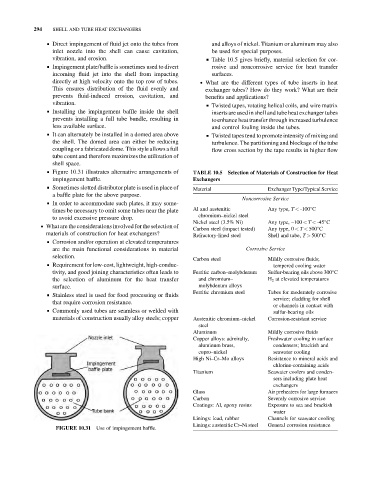
                 & Figure 10.31 illustrates alternative arrangements of
                                                                 TABLE 10.5 Selection of Materials of Construction for Heat
                  impingement baffle.                             Exchangers
                 & Sometimes slotted distributor plate is used in place of
                                                                 Material                Exchanger Type/Typical Service
                  a baffle plate for the above purpose.
                                                                                 Noncorrosive Service
                 & In order to accommodate such plates, it may some-

                  times be necessary to omit some tubes near the plate  Al and austenitic  Any type, T < -100 C
                                                                   chromium–nickel steel
                  to avoid excessive pressure drop.
                                                                 Nickel steel (3.5% Ni)  Any type, –100 < T < -45 C

               . What are the considerations involved for the selection of

                                                                 Carbon steel (impact tested)  Any type, 0 < T < 500 C
                materials of construction for heat exchangers?   Refractory-lined steel  Shell and tube, T > 500 C

                 & Corrosion and/or operation at elevated temperatures
                  are the main functional considerations in material              Corrosive Service
                  selection.
                                                                 Carbon steel            Mildly corrosive fluids;
                 & Requirement for low-cost, lightweight, high-conduc-                     tempered cooling water
                  tivity, and good joining characteristics often leads to  Ferritic carbon–molybdenum  Sulfur-bearing oils above 300 C

                  the selection of aluminum for the heat transfer  and chromium–         H 2 at elevated temperatures
                  surface.                                         molybdenum alloys
                                                                 Ferritic chromium steel  Tubes for moderately corrosive
                 & Stainless steel is used for food processing or fluids
                                                                                           service; cladding for shell
                  that require corrosion resistance.
                                                                                           or channels in contact with
                 & Commonly used tubes are seamless or welded with
                                                                                           sulfur-bearing oils
                  materials of construction usually alloy steels; copper  Austenitic chromium–nickel  Corrosion-resistant service
                                                                   steel
                                                                 Aluminum                Mildly corrosive fluids
                                                                 Copper alloys: admiralty,  Freshwater cooling in surface
                                                                   aluminum brass,         condensers; brackish and
                                                                   cupro–nickel            seawater cooling
                                                                 High Ni–Cr–Mo alloys    Resistance to mineral acids and
                                                                                           chlorine-containing acids
                                                                 Titanium                Seawater coolers and conden-
                                                                                           sers including plate heat
                                                                                           exchangers
                                                                 Glass                   Air preheaters for large furnaces
                                                                 Carbon                  Severely corrosive service
                                                                 Coatings: Al, epoxy resins  Exposure to sea and brackish
                                                                                           water
                                                                 Linings: lead, rubber   Channels for seawater cooling
                                                                 Linings: austenitic Cr–Ni steel  General corrosion resistance
                   FIGURE 10.31 Use of impingement baffle.

