


Page 312 - Fluid mechanics, heat transfer, and mass transfer
P. 312
HEAT EXCHANGERS    293

                & Not less than 16% of shell diameter.               & Baffle spacing/tube diameter ¼ 30–40.
                & Normal pitch is 20% of shell diameter.             & Baffle height/shell diameter ¼ 0.75.
              . What is the effect of increasing number of baffles in a  . What are the disadvantages of using baffles in the shell
                heat exchanger?                                     side and on the passes in a heat exchanger?
                & Velocity and DP on the shell side increase.        & Pressure drop will increase.
                & Doubling number of baffles doubles velocity across  . What is a Helixchanger heat exchanger? How does it
                  tube bundle and increase DP by four times.        reduce fouling rates compared to conventional shell
              . On what consideration maximum baffle spacing is      and tube exchanger?
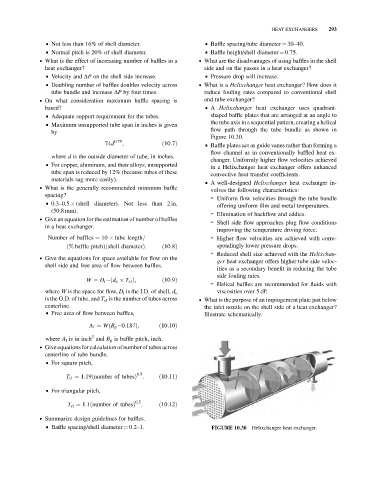
                based?                                               & A Helixchanger heat exchanger uses quadrant-
                & Adequate support requirement for the tubes.          shaped baffle plates that are arranged at an angle to
                                                                       the tube axis in a sequential pattern, creating a helical
                & Maximum unsupported tube span in inches is given
                                                                       flow path through the tube bundle as shown in
                  by
                                                                       Figure 10.30.
                                    74d 0:75 ;         ð10:7Þ        & Baffle plates act as guide vanes rather than forming a
                                                                       flow channel as in conventionally baffled heat ex-
                  where d is the outside diameter of tube, in inches.
                                                                       changer. Uniformly higher flow velocities achieved
                & For copper, aluminum, and their alloys, unsupported
                                                                       in a Helixchanger heat exchanger offers enhanced
                  tube span is reduced by 12% (because tubes of these
                                                                       convective heat transfer coefficients.
                  materials sag more easily).
                                                                     & A well-designed Helixchanger heat exchanger in-
              . What is the generally recommended minimum baffle
                                                                       volves the following characteristics:
                spacing?
                                                                       ➢ Uniform flow velocities through the tube bundle
                & 0.3–0.5   (shell diameter). Not less than 2 in.
                                                                         offering uniform film and metal temperatures.
                  (50.8 mm).
                                                                       ➢ Elimination of backflow and eddies.
              . Give an equation for the estimation of number of baffles
                                                                       ➢ Shell side flow approaches plug flow conditions
                in a heat exchanger.
                                                                         improving the temperature driving force.
                 Number of baffles ¼ 10   tube length=                 ➢ Higher flow velocities are achieved with corre-
                       ð% baffle pitchÞðshell diameterÞ:  ð10:8Þ         spondingly lower pressure drops.
                                                                       ➢ Reduced shell size achieved with the Helixchan-
              . Give the equations for space available for flow on the
                                                                         ger heat exchanger offers higher tube side veloc-
                shell side and free area of flow between baffles.
                                                                         ities as a secondary benefit in reducing the tube
                                                                         side fouling rates.
                              W ¼ D i  ðd o   T cl Þ;  ð10:9Þ
                                                                       ➢  Helical baffles are recommended for fluids with
                                                                         viscosities over 5 cP.
                where W is the space for flow, D i is the I.D. of shell, d o
                is the O.D. of tube, and T cl is the number of tubes across  . What is the purpose of an impingement plate just below
                centerline.                                         the inlet nozzle on the shell side of a heat exchanger?
                & Free area of flow between baffles,
                                                                    Illustrate schematically.
                               A f ¼ WðB p  0:187Þ;   ð10:10Þ
                               2
                where A f is in inch and B p is baffle pitch, inch.
              . Giveequations for calculation of number of tubes across
                centerline of tube bundle.
                & For square pitch,

                                              0:5
                       T cl ¼ 1:19ðnumber of tubesÞ :  ð10:11Þ
                & For triangular pitch,

                                              0:5
                       T cl ¼ 1:1ðnumber of tubesÞ :  ð10:12Þ
              . Summarize design guidelines for baffles.
                & Baffle spacing/shell diameter ¼ 0.2–1.                FIGURE 10.30 Helixchanger heat exchanger.

