


Page 308 - Fluid mechanics, heat transfer, and mass transfer
P. 308
HEAT EXCHANGERS    289


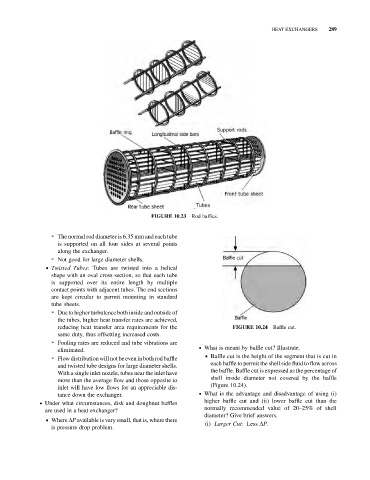
                                                                Rod baffles.
                                                   FIGURE 10.23

                  ➢ The normal rod diameter is 6.35 mm and each tube
                    is supported on all four sides at several points
                    along the exchanger.
                  ➢ Not good for large diameter shells.
                & Twisted Tubes: Tubes are twisted into a helical
                  shape with an oval cross section, so that each tube
                  is supported over its entire length by multiple
                  contact points with adjacent tubes. The end sections
                  are kept circular to permit mounting in standard
                  tube sheets.
                  ➢ Due to higher turbulence both inside and outside of
                    the tubes, higher heat transfer rates are achieved,
                    reducing heat transfer area requirements for the          FIGURE 10.24 Baffle cut.
                    same duty, thus offsetting increased costs.
                  ➢ Fouling rates are reduced and tube vibrations are
                                                                   . What is meant by baffle cut? Illustrate.
                    eliminated.
                                                                     & Baffle cut is the height of the segment that is cut in
                  ➢ Flow distribution will not be evenin both rod baffle
                                                                       each baffle to permit the shell side fluid to flow across
                    and twisted tube designs for large diameter shells.
                                                                       the baffle. Baffle cut is expressed as the percentage of
                    With a single inlet nozzle, tubes near the inlet have
                                                                       shell inside diameter not covered by the baffle
                    more than the average flow and those opposite to
                                                                       (Figure 10.24).
                    inlet will have low flows for an appreciable dis-
                    tance down the exchanger.                      . What is the advantage and disadvantage of using (i)
                                                                    higher baffle cut and (ii) lower baffle cut than the
              . Under what circumstances, disk and doughnut baffles
                                                                    normally recommended value of 20–25% of shell
                are used in a heat exchanger?
                                                                    diameter? Give brief answers.
                & Where DP available is very small, that is, where there
                                                                     (i) Larger Cut: Less DP.
                  is pressure drop problem.

