


Page 303 - Fluid mechanics, heat transfer, and mass transfer
P. 303
SHELL AND TUBE HEAT EXCHANGERS
            284
                                                                     & Other Liquids:
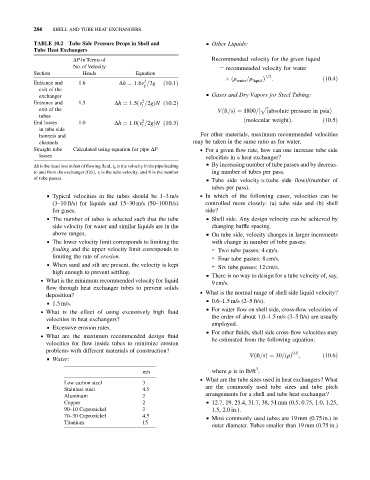
            TABLE 10.2 Tube Side Pressure Drops in Shell and
            Tube Heat Exchangers
                         DP in Terms of                                Recommended velocity for the given liquid
                         No. of Velocity                                  ¼ recommended velocity for water
            Section         Heads             Equation                                   1=2
                                                                            ðr    =r    Þ  :                ð10:4Þ
                                                 2
            Entrance and   1.6          Dh ¼ 1:6v =2g  ð10:1Þ                  water  liquid
                                                 p
              exit of the
              exchanger                                              & Gases and Dry Vapors for Steel Tubing:
                                                2
            Entrance and   1.5         Dh ¼ 1:5ðv =2gÞN ð10:2Þ
                                                t
              exit of the                                                              p ffiffi
                                                                         Vðft=sÞ¼ 1800=½  ðabsolute pressure in psiaÞ
              tubes
                                                2
            End losses     1.0         Dh ¼ 1:0ðv =2gÞN ð10:3Þ                   ðmolecular weightÞ:        ð10:5Þ
                                                t
              in tube side
              bonnets and                                          For other materials, maximum recommended velocities
              channels                                           may be taken in the same ratio as for water.
            Straight tube  Calculated using equation for pipe DP   . For a given flow rate, how can one increase tube side
              losses                                                 velocities in a heat exchanger?
                                                                     & By increasing number of tube passes and by decreas-
            Dh is the head loss in feet offlowing fluid, v p is thevelocity in the pipe leading
            to and from the exchanger (ft/s), v t is the tube velocity, and N is the number  ing number of tubes per pass.
            of tube passes.
                                                                     & Tube side velocity / (tube side flow)/(number of
                                                                       tubes per pass).
                 & Typical velocities in the tubes should be 1–3 m/s  . In which of the following cases, velocities can be
                  (3–10 ft/s) for liquids and 15–30 m/s (50–100 ft/s)  controlled more closely: (a) tube side and (b) shell
                  for gases.                                         side?
                 & The number of tubes is selected such that the tube  & Shell side. Any design velocity can be achieved by
                  side velocity for water and similar liquids are in the  changing baffle spacing.
                  above ranges.                                      & On tube side, velocity changes in larger increments
                 & The lower velocity limit corresponds to limiting the  with change in number of tube passes:
                  fouling and the upper velocity limit corresponds to  ➢ Two tube passes: 4 cm/s.
                  limiting the rate of erosion.                        ➢ Four tube passes: 8 cm/s.
                 & When sand and silt are present, the velocity is kept
                                                                       ➢  Six tube passes: 12 cm/s.
                  high enough to prevent settling.
                                                                     & There is no way to design for a tube velocity of, say,
               . What is the minimum recommended velocity for liquid
                                                                       9 cm/s.
                flow through heat exchanger tubes to prevent solids
                                                                   . What is the normal range of shell side liquid velocity?
                deposition?
                                                                     & 0.6–1.5 m/s (2–5 ft/s).
                 & 1.5 m/s.
                                                                     & For water flow on shell side, cross-flow velocities of
               . What is the effect of using excessively high fluid
                                                                       the order of about 1.0–1.5 m/s (3–5 ft/s) are usually
                velocities in heat exchangers?
                                                                       employed.
                 & Excessive erosion rates.
                                                                     & For other fluids, shell side cross-flow velocities may
               . What are the maximum recommended design fluid
                                                                       be estimated from the following equation:
                velocities for flow inside tubes to minimize erosion
                problems with different materials of construction?                                0:5
                                                                                   Vðft=sÞ¼ 30=ðrÞ ;        ð10:6Þ
                 & Water:
                                                                                      3
                                                m/s                    where r is in lb/ft .
                                                                   . What are the tube sizes used in heat exchangers? What
                      Low carbon steel          3
                                                                     are the commonly used tube sizes and tube pitch
                      Stainless steel           4.5
                      Aluminum                  2                    arrangements for a shell and tube heat exchanger?
                      Copper                    2                    & 12.7, 19, 25.4, 31.7, 38, 51 mm (0.5, 0.75, 1.0, 1.25,
                      90–10 Cupronickel         3                      1.5, 2.0 in.).
                      70–30 Cupronickel         4.5                  & Most commonly used tubes are 19 mm (0.75 in.) in
                      Titanium                  15
                                                                       outer diameter. Tubes smaller than 19 mm (0.75 in.)

