


Page 301 - Fluid mechanics, heat transfer, and mass transfer
P. 301
SHELL AND TUBE HEAT EXCHANGERS
            282
               . What are the normal margins of safety adopted while   necessary to design the exchanger, taking into
                specifying design pressures and temperatures for       consideration such developments as mentioned
                TEMA-specified exchangers?                              above.
                 & About 200 kPa greater than maximum expected dur-  & Erosion problems should be controlled by control-
                  ing operation or at pump shutoff.                    ling flow velocities, especially in bends and other
                 & About 14 C greater than maximum temperature         direction change areas, filtering the fluids from

                  while in service.                                    debris and particulate matter and other measures.
               . What are the recommended maximum distances for    . How are the number of tube passes increased for an
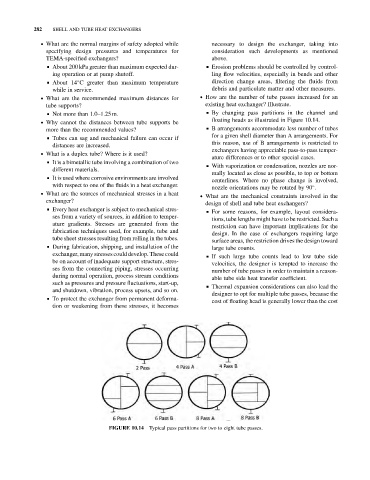
                tube supports?                                       existing heat exchanger? Illustrate.
                 & Not more than 1.0–1.25 m.                         & By changing pass partitions in the channel and
                                                                       floating heads as illustrated in Figure 10.14.
               . Why cannot the distances between tube supports be
                more than the recommended values?                    & B arrangements accommodate less number of tubes
                                                                       for a given shell diameter than A arrangements. For
                 & Tubes can sag and mechanical failure can occur if
                                                                       this reason, use of B arrangements is restricted to
                  distances are increased.
                                                                       exchangers having appreciable pass-to-pass temper-
               . What is a duplex tube? Where is it used?
                                                                       ature differences or to other special cases.
                 & It is a bimetallic tube involving a combination of two
                                                                     & With vaporization or condensation, nozzles are nor-
                  different materials.
                                                                       mally located as close as possible, to top or bottom
                 & It is used where corrosive environments are involved
                                                                       centerlines. Where no phase change is involved,
                  with respect to one of the fluids in a heat exchanger.
                                                                       nozzle orientations may be rotated by 90 .
               . What are the sources of mechanical stresses in a heat
                                                                   . What are the mechanical constraints involved in the
                exchanger?
                                                                     design of shell and tube heat exchangers?
                 & Every heat exchanger is subject to mechanical stres-
                                                                     & For some reasons, for example, layout considera-
                  ses from a variety of sources, in addition to temper-
                                                                       tions, tube lengths might have to be restricted. Such a
                  ature gradients. Stresses are generated from the
                                                                       restriction can have important implications for the
                  fabrication techniques used, for example, tube and
                                                                       design. In the case of exchangers requiring large
                  tube sheet stresses resulting from rolling in the tubes.
                                                                       surface areas, the restriction drives the design toward
                 & During fabrication, shipping, and installation of the
                                                                       large tube counts.
                  exchanger, many stresses could develop. These could  & If such large tube counts lead to low tube side
                  be on account of inadequate support structure, stres-
                                                                       velocities, the designer is tempted to increase the
                  ses from the connecting piping, stresses occurring
                                                                       number of tube passes in order to maintain a reason-
                  during normal operation, process stream conditions
                                                                       able tube side heat transfer coefficient.
                  such as pressures and pressure fluctuations, start-up,
                                                                     & Thermal expansion considerations can also lead the
                  and shutdown, vibration, process upsets, and so on.
                                                                       designer to opt for multiple tube passes, because the
                 & To protect the exchanger from permanent deforma-
                                                                       cost of floating head is generally lower than the cost
                  tion or weakening from these stresses, it becomes


                                     FIGURE 10.14 Typical pass partitions for two to eight tube passes.

