


Page 306 - Fluid mechanics, heat transfer, and mass transfer
P. 306
HEAT EXCHANGERS    287

                      for a given shell diameter, tube sheet becomes  TABLE 10.3 Maximum Unsupported Span for the Tubes
                      too weak.
                                                                                            Maximum Unsupported
                    - Access for maintenance of tube bundles be-                                 Span (mm)
                      comes more difficult.
              . What is the recommended range of optimum tube pitch  Approximate O.D.   Group A          Group B
                to tube diameter ratio for conversion of pressure drop to  of Tube (mm)  Materials       Materials
                heat transfer?                                  19                        1520             1321
                                                                25                        1880             1626
                & Pressure drop–heat transfer relationships: Higher
                                                                32                        2240             1930
                  turbulence is achieved at the expense of higher  38                     2540             2210
                  pressure drops.                               50                        3175             2794
                & Increased turbulence increases heat transfer rates.
                                                                Group A: Carbon and high alloy steel, low alloy steel, nickel–copper, nickel,
                & In the design of exchangers, these two variables are to  nickel–chromium–iron. Group B: Aluminum and aluminum alloys, copper
                  be optimized in order to achieve the best possible  and copper alloys, titanium and zirconium.
                  energy economy in terms of heat transferred and
                  energy expended on pumping to overcome pressure
                  drops.                                               ➢ To enable a desirable velocity to be maintained for
                                                                         the shell side fluid.
                & The optimum tube pitch to tube diameter ratio for
                  conversion of pressure drop to heat transfer is typ-  ➢ To increase turbulence and reduce stagnant pock-
                  ically 1.25–1.35 for turbulent flow and around 1.4 for  ets in the exchanger.
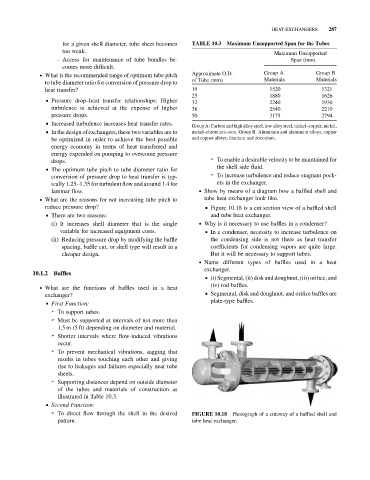
                  laminar flow.                                     . Show by means of a diagram how a baffled shell and
              . What are the reasons for not increasing tube pitch to  tube heat exchanger look like.
                reduce pressure drop?                                & Figure 10.18 is a cut section view of a baffled shell
                & There are two reasons:                               and tube heat exchanger.
                  (i) It increases shell diameter that is the single  . Why is it necessary to use baffles in a condenser?
                     variable for increased equipment costs.         & In a condenser, necessity to increase turbulence on
                  (ii) Reducing pressure drop by modifying the baffle   the condensing side is not there as heat transfer
                     spacing, baffle cut, or shell type will result in a  coefficients for condensing vapors are quite large.
                     cheaper design.                                   But it will be necessary to support tubes.
                                                                   . Name different types of baffles used in a heat
                                                                    exchanger.
            10.1.2  Baffles
                                                                     & (i) Segmental, (ii) disk and doughnut, (iii) orifice, and
                                                                       (iv) rod baffles.
              . What are the functions of baffles used in a heat
                exchanger?                                           & Segmental, disk and doughnut, and orifice baffles are
                                                                       plate-type baffles.
                & First Function:
                  ➢ To support tubes.
                  ➢ Must be supported at intervals of not more than
                    1.5 m (5 ft) depending on diameter and material.
                  ➢ Shorter intervals where flow-induced vibrations
                    occur.
                  ➢ To prevent mechanical vibrations, sagging that
                    results in tubes touching each other and giving
                    rise to leakages and failures especially near tube
                    sheets.
                  ➢ Supporting distances depend on outside diameter
                    of the tubes and materials of construction as
                    illustrated in Table 10.3.
                & Second Function:
                  ➢ To direct flow through the shell in the desired  FIGURE 10.18 Photograph of a cutaway of a baffled shell and
                    pattern.                                    tube heat exchanger.

