


Page 309 - Fluid mechanics, heat transfer, and mass transfer
P. 309
SHELL AND TUBE HEAT EXCHANGERS
            290


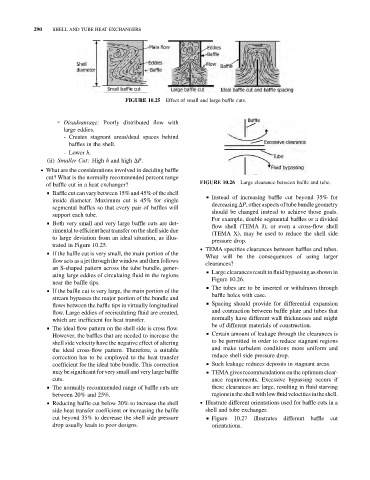
                                          FIGURE 10.25 Effect of small and large baffle cuts.


                    ➢ Disadvantage: Poorly distributed flow with
                      large eddies.
                      - Creates stagnant areas/dead spaces behind
                        baffles in the shell.
                      - Lower h.
                 (ii) Smaller Cut: High h and high DP.
               . What are the considerations involved in deciding baffle
                cut? What is the normally recommended percent range
                of baffle cut in a heat exchanger?                  FIGURE 10.26  Large clearance between baffle and tube.
                 & Baffle cut canvary between 15% and 45% of the shell
                                                                     & Instead of increasing baffle cut beyond 35% for
                  inside diameter. Maximum cut is 45% for single
                                                                       decreasing DP, other aspects of tube bundlegeometry
                  segmental baffles so that every pair of baffles will
                                                                       should be changed instead to achieve those goals.
                  support each tube.
                                                                       For example, double segmental baffles or a divided
                 & Both very small and very large baffle cuts are det-
                                                                       flow shell (TEMA J), or even a cross-flow shell
                  rimental to efficient heat transfer on the shell side due
                                                                       (TEMA X), may be used to reduce the shell side
                  to large deviation from an ideal situation, as illus-
                                                                       pressure drop.
                  trated in Figure 10.25.
                                                                   . TEMA specifies clearances between baffles and tubes.
                 & If the baffle cut is very small, the main portion of the
                                                                     What will be the consequences of using larger
                  flow acts as a jet through thewindow and then follows
                                                                     clearances?
                  an S-shaped pattern across the tube bundle, gener-
                                                                     & Large clearances result in fluid bypassing as shown in
                  ating large eddies of circulating fluid in the regions
                                                                       Figure 10.26.
                  near the baffle tips.
                                                                     & The tubes are to be inserted or withdrawn through
                 & If the baffle cut is very large, the main portion of the
                                                                       baffle holes with ease.
                  stream bypasses the major portion of the bundle and
                                                                     & Spacing should provide for differential expansion
                  flows between the baffle tips in virtually longitudinal
                  flow. Large eddies of recirculating fluid are created,  and contraction between baffle plate and tubes that
                  which are inefficient for heat transfer.              normally have different wall thicknesses and might
                                                                       be of different materials of construction.
                 & The ideal flow pattern on the shell side is cross flow.
                                                                     & Certain amount of leakage through the clearances is
                  However, the baffles that are needed to increase the
                  shell side velocity have the negative effect of altering  to be permitted in order to reduce stagnant regions
                  the ideal cross-flow pattern. Therefore, a suitable   and make turbulent conditions more uniform and
                  correction has to be employed to the heat transfer   reduce shell side pressure drop.
                  coefficient for the ideal tube bundle. This correction  & Such leakage reduces deposits in stagnant areas.
                  may be significant for very small and very large baffle  & TEMA gives recommendations on the optimum clear-
                  cuts.                                                ance requirements. Excessive bypassing occurs if
                 & The normally recommended range of baffle cuts are    these clearances are large, resulting in fluid starving
                  between 20% and 25%.                                 regionsintheshellwithlowfluidvelocitiesintheshell.
                 & Reducing baffle cut below 20% to increase the shell  . Illustrate different orientations used for baffle cuts in a
                  side heat transfer coefficient or increasing the baffle  shell and tube exchanger.
                  cut beyond 35% to decrease the shell side pressure  & Figure  10.27  illustrates  different  baffle  cut
                  drop usually leads to poor designs.                  orientations.

