


Page 326 - Fluid mechanics, heat transfer, and mass transfer
P. 326
HEAT EXCHANGERS    307

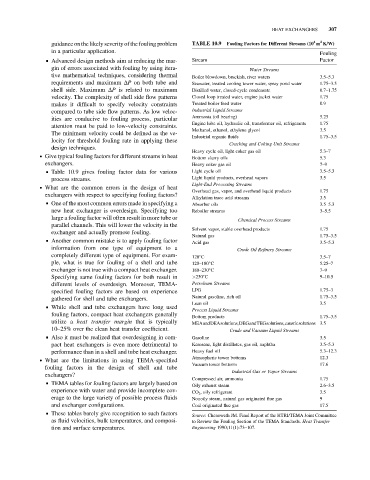
                  guidance on the likely severity of the fouling problem  TABLE 10.9  Fouling Factors for Different Streams (10 m K/W)
                                                                                                         4
                                                                                                           2
                  in a particular application.
                                                                                                           Fouling
                & Advanced design methods aim at reducing the mar-  Stream                                 Factor
                  gin of errors associated with fouling by using itera-            Water Streams
                  tive mathematical techniques, considering thermal  Boiler blowdown, brackish, river waters  3.5–5.3
                  requirements and maximum DP on both tube and  Seawater, treated cooling tower water, spray pond water  1.75–3.5
                  shell side. Maximum DP is related to maximum  Distilled water, closed-cycle condensate   0.7–1.75
                  velocity. The complexity of shell side flow patterns  Closed loop treated water, engine jacket water  1.75
                  makes it difficult to specify velocity constraints  Treated boiler feed water             0.9
                  compared to tube side flow patterns. As low veloc-  Industrial Liquid Streams
                  ities are conducive to fouling process, particular  Ammonia (oil bearing)                5.25
                                                                Engine lube oil, hydraulic oil, transformer oil, refrigerants  1.75
                  attention must be paid to low-velocity constraints.
                                                                Methanol, ethanol, ethylene glycol         3.5
                  The minimum velocity could be defined as the ve-
                                                                Industrial organic fluids                   1.75–3.5
                  locity for threshold fouling rate in applying these
                                                                             Cracking and Coking Unit Streams
                  design techniques.
                                                                Heavy cycle oil, light coker gas oil       5.3–7
              . Give typical fouling factors for different streams in heat
                                                                Bottom slurry oils                         5.3
                exchangers.                                     Heavy coker gas oil                        7–9
                & Table 10.9 gives fouling factor data for various  Light cycle oil                        3.5–5.3
                  process streams.                              Light liquid products, overhead vapors     3.5
                                                                Light-End Processing Streams
              . What are the common errors in the design of heat
                                                                Overhead gas, vapor, and overhead liquid products  1.75
                exchangers with respect to specifying fouling factors?
                                                                Alkylation trace acid streams              3.5
                & One of the most common errors made in specifying a  Absorber oils                        3.5–5.3
                  new heat exchanger is overdesign. Specifying too  Reboiler streams                       3–5.5
                  large a fouling factor will often result in more tube or      Chemical Process Streams
                  parallel channels. This will lower the velocity in the
                                                                Solvent vapor, stable overhead products    1.75
                  exchanger and actually promote fouling.
                                                                Natural gas                                1.75–3.5
                & Another common mistake is to apply fouling factor
                                                                Acid gas                                   3.5–5.3
                  information from one type of equipment to a                  Crude Oil Refinery Streams
                  completely different type of equipment. For exam-  120 C                                 3.5–7

                  ple, what is true for fouling of a shell and tube  120–180 C                             5.25–7

                  exchanger is not true with a compact heat exchanger.  180–230 C                          7–9

                  Specifying same fouling factors for both result in  >230 C                               9–10.5

                  different levels of overdesign. Moreover, TEMA-  Petroleum Streams
                  specified fouling factors are based on experience  LPG                                    1.75–3
                  gathered for shell and tube exchangers.       Natural gasoline, rich oil                 1.75–3.5
                                                                Lean oil                                   3.5
                & While shell and tube exchangers have long used
                                                                Process Liquid Streams
                  fouling factors, compact heat exchangers generally  Bottom products                      1.75–3.5
                  utilize a heat transfer margin that is typically  MEAandDEAsolutions,DEGandTEGsolutions,causticsolutions 3.5
                  10–25% over the clean heat transfer coefficient.            Crude and Vacuum Liquid Streams
                & Also it must be realized that overdesigning in com-  Gasoline                            3.5
                  pact heat exchangers is even more detrimental to  Kerosene, light distillates, gas oil, naphtha  3.5–5.3
                  performance than in a shell and tube heat exchanger.  Heavy fuel oil                     5.3–12.3
                                                                Atmospheric tower bottoms                  12.3
              . What are the limitations in using TEMA-specified
                                                                Vacuum tower bottoms                       17.6
                fouling factors in the design of shell and tube
                                                                              Industrial Gas or Vapor Streams
                exchangers?
                                                                Compressed air, ammonia                    1.75
                & TEMA tables for fouling factors are largely based on
                                                                Oily exhaust steam                         2.6–3.5
                  experience with water and provide incomplete cov-  CO 2 , oily refrigerant               3.5
                  erage to the large variety of possible process fluids  Nonoily steam, natural gas originated flue gas  9
                  and exchanger configurations.                  Coal originated flue gas                    17.5
                & These tables barely give recognition to such factors
                                                                Source: Chenoweth JM. Final Report of the HTRI/TEMA Joint Committee
                  as fluid velocities, bulk temperatures, and composi-  to Review the Fouling Section of the TEMA Standards. Heat Transfer
                  tion and surface temperatures.                Engineering 1990;11(1):73–107.

