


Page 331 - Fluid mechanics, heat transfer, and mass transfer
P. 331
SHELL AND TUBE HEAT EXCHANGERS
312
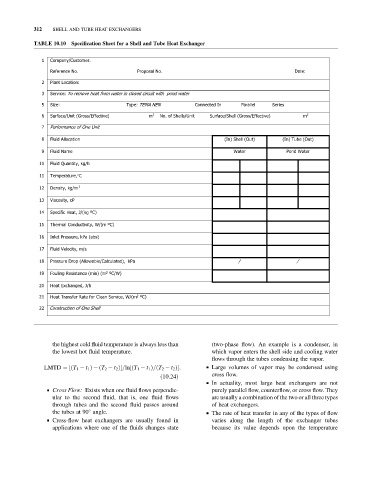
TABLE 10.10 Specification Sheet for a Shell and Tube Heat Exchanger
1 Company/Customer.
Reference No. Proposal No. Date:
2 Plant Location:
3 Service: To remove heat from water in closed circuit with pond water
5 Size: Type: TEMA NEN Connected In Parallel Series
2
6 Surface/Unit (Gross/Effective) m No. of Shells/Unit Surface/Shell (Gross/Effective) m 2
7 Performance of One Unit
8 Fluid Allocation (In) Shell (Out) (In) Tube (Out)
9 Fluid Name Water Pond Water
10 Fluid Quantity, kg/h
11 Temperature, C
12 Density, kg/m 3
13 Viscosity, cP
14 Specific Heat, J/(kg ºC)
15 Thermal Conductivity, W/(m ºC)
16 Inlet Pressure, kPa (abs)
17 Fluid Velocity, m/s
18 Pressure Drop (Allowable/Calculated), kPa / /
2
19 Fouling Resistance (min) (m ºC/W)
20 Heat Exchanged, J/h
2
21 Heat Transfer Rate for Clean Service, W/(m ºC)
22 Construction of One Shell
the highest cold fluid temperature is always less than (two-phase flow). An example is a condenser, in
the lowest hot fluid temperature. which vapor enters the shell side and cooling water
flows through the tubes condensing the vapor.
LMTD ¼½ðT 1 t 1 Þ ðT 2 t 2 Þ=ln½ðT 1 t 1 Þ=ðT 2 t 2 Þ: & Large volumes of vapor may be condensed using
cross flow.
ð10:24Þ
& In actuality, most large heat exchangers are not
& Cross Flow: Exists when one fluid flows perpendic- purely parallel flow, counterflow, or cross flow. They
ular to the second fluid, that is, one fluid flows are usually a combination of the two or all three types
through tubes and the second fluid passes around of heat exchangers.
the tubes at 90 angle. & The rate of heat transfer in any of the types of flow
& Cross-flow heat exchangers are usually found in varies along the length of the exchanger tubes
applications where one of the fluids changes state because its value depends upon the temperature

