


Page 333 - Fluid mechanics, heat transfer, and mass transfer
P. 333
SHELL AND TUBE HEAT EXCHANGERS
            314
                                                                     & The outlet temperature of the cold fluid can approach
                                                                       the highest temperature of the hot fluid (the inlet
                                                                       temperature).
                                                                     & The more uniform temperature difference between
                                                                       the two fluids minimizes the thermal stresses
                                                                       throughout the exchanger and produces a more uni-
                                                                       form rate of heat transfer throughout the heat
                                                                       exchanger.
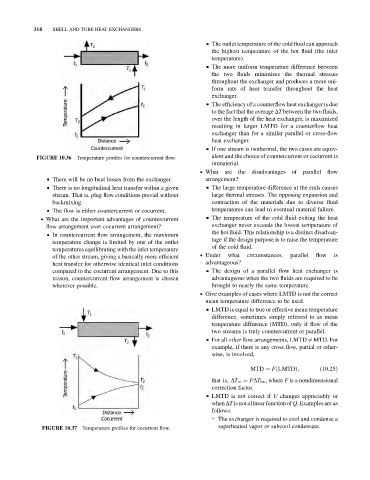
                                                                     & The efficiency of a counterflow heat exchanger is due
                                                                       to the fact that the average DT between the two fluids,
                                                                       over the length of the heat exchanger, is maximized
                                                                       resulting in larger LMTD for a counterflow heat
                                                                       exchanger than for a similar parallel or cross-flow
                                                                       heat exchanger.
                                                                     & If one stream is isothermal, the two cases are equiv-
             FIGURE 10.36 Temperature profiles for countercurrent flow.  alent and the choice of countercurrent or cocurrent is
                                                                       immaterial.
                                                                   . What  are  the  disadvantages  of  parallel  flow
                 & There will be no heat losses from the exchanger.  arrangement?
                 & There is no longitudinal heat transfer within a given  & The large temperature difference at the ends causes
                  stream. That is, plug flow conditions prevail without  large thermal stresses. The opposing expansion and
                  backmixing.                                          contraction of the materials due to diverse fluid
                 & The flow is either countercurrent or cocurrent.      temperatures can lead to eventual material failure.
               . What are the important advantages of countercurrent  & The temperature of the cold fluid exiting the heat
                flow arrangement over cocurrent arrangement?            exchanger never exceeds the lowest temperature of
                                                                       the hot fluid. This relationship is a distinct disadvan-
                 & In countercurrent flow arrangement, the maximum
                                                                       tage if the design purpose is to raise the temperature
                  temperature change is limited by one of the outlet
                                                                       of the cold fluid.
                  temperatures equilibrating with the inlet temperature
                  of the other stream, giving a basically more efficient  . Under  what  circumstances,  parallel  flow  is
                  heat transfer for otherwise identical inlet conditions  advantageous?
                  compared to the cocurrent arrangement. Due to this  & The design of a parallel flow heat exchanger is
                  reason, countercurrent flow arrangement is chosen     advantageous when the two fluids are required to be
                  wherever possible.                                   brought to nearly the same temperature.
                                                                   . Give examples of cases where LMTD is not the correct
                                                                     mean temperature difference to be used.
                                                                     & LMTD is equal to true or effective mean temperature
                                                                       difference, sometimes simply referred to as mean
                                                                       temperature difference (MTD), only if flow of the
                                                                       two streams is truly countercurrent or parallel.
                                                                     & For all other flow arrangements, LMTD 6¼ MTD. For
                                                                       example, if there is any cross flow, partial or other-
                                                                       wise, is involved,

                                                                                    MTD ¼ FðLMTDÞ;         ð10:25Þ
                                                                       that is; DT m ¼ FDT lm ; where F is a nondimensional
                                                                       correction factor.
                                                                     & LMTD is not correct if U changes appreciably or
                                                                       when DT is not a linear function of Q. Examples are as
                                                                       follows:
                                                                       ➢ The exchanger is required to cool and condense a
                            Temperature profiles for cocurrent flow.       superheated vapor or subcool condensate.
               FIGURE 10.37

