


Page 334 - Fluid mechanics, heat transfer, and mass transfer
P. 334
HEAT EXCHANGERS    315

                                                                     & True. One of the fluids, that is, condensing fluid, is at
                                                                       constant temperature, provided the exchanger is
                                                                       functioning only as a condenser and neither desu-
                                                                       perheating nor subcooling is involved.
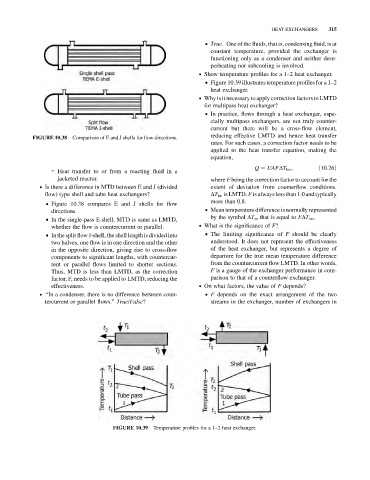
                                                                   . Show temperature profiles for a 1–2 heat exchanger.
                                                                     & Figure 10.39 illustrates temperature profiles for a 1–2
                                                                       heat exchanger.
                                                                   . Why is it necessary to apply correction factors to LMTD
                                                                    for multipass heat exchanger?
                                                                     & In practice, flows through a heat exchanger, espe-
                                                                       cially multipass exchangers, are not truly counter-
                                                                       current but there will be a cross-flow element,
                                                                       reducing effective LMTD and hence heat transfer
            FIGURE 10.38 Comparison of E and J shells for flow directions.
                                                                       rates. For such cases, a correction factor needs to be
                                                                       applied to the heat transfer equation, making the
                                                                       equation,
                                                                                     Q ¼ UAFDT lm ;       ð10:26Þ
                  ➢ Heat transfer to or from a reacting fluid in a
                    jacketed reactor.                                  where F being the correction factor to account for the
              . Is there a difference in MTD between E and J (divided  extent of deviation from counterflow conditions.
                flow) type shell and tube heat exchangers?              DT lm is LMTD. F is always less than 1.0 and typically
                                                                       more than 0.8.
                & Figure 10.38 compares E and J shells for flow
                  directions.                                        & Mean temperature difference is normally represented
                                                                       by the symbol DT m that is equal to FDT lm .
                & In the single-pass E-shell, MTD is same as LMTD,
                  whether the flow is countercurrent or parallel.   . What is the significance of F?
                & In the split flow J-shell, the shell length is divided into  & The limiting significance of F should be clearly
                  two halves, one flow is in one direction and the other  understood. It does not represent the effectiveness
                  in the opposite direction, giving rise to cross-flow  of the heat exchanger, but represents a degree of
                  components to significant lengths, with countercur-   departure for the true mean temperature difference
                  rent or parallel flows limited to shorter sections.   from the countercurrent flow LMTD. In other words,
                  Thus, MTD is less than LMTD, as the correction       F is a gauge of the exchanger performance in com-
                  factor, F, needs to be applied to LMTD, reducing the  parison to that of a counterflow exchanger.
                  effectiveness.                                   . On what factors, the value of F depends?
              . ‘‘In a condenser, there is no difference between coun-  & F depends on the exact arrangement of the two
                tercurrent or parallel flows.’’ True/False?             streams in the exchanger, number of exchangers in


                                                    Temperature profiles for a 1–2 heat exchanger.
                                      FIGURE 10.39

