


Page 342 - Fluid mechanics, heat transfer, and mass transfer
P. 342
THERMAL DESIGN OF SHELL AND TUBE HEAT EXCHANGERS 323
➢ For countercurrent flow, C min ¼ smaller of ðmC P Þ and ðmC P Þ : ð10:55Þ
hot cold
« ¼½1 expf ðUA=C min Þð1 C min =C max Þg= & NTU designates nondimensional heat transfer size
or thermal size of a heat exchanger. Physical size is
½1 ðC min =C max Þexpf ðUA=C min Þ
heat transfer area.
ð1 C min =C max Þg: ð10:51Þ
& Physical significance of NTU: Ratio of heat capacity
➢ For parallel flow, of exchanger, W/ C divided by heat capacity of flow,
W/ C.
« ¼½1 expf ðUA=C min Þð1 þ C min =C max Þg=
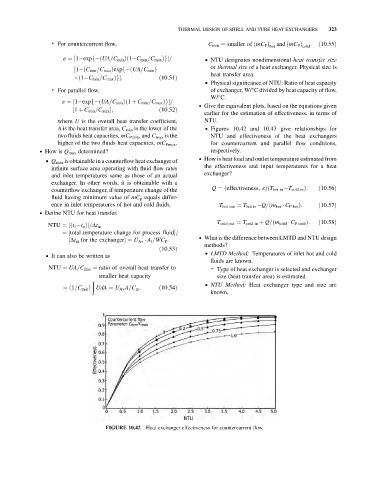
. Give the equivalent plots, based on the equations given
½1 þ C min =C max ; ð10:52Þ
earlier for the estimation of effectiveness, in terms of
where U is the overall heat transfer coefficient, NTU.
A is the heat transfer area, C min is the lower of the & Figures 10.42 and 10.43 give relationships for
two fluids heat capacities, mC Pmin , and C max is the NTU and effectiveness of the heat exchangers
higher of the two fluids heat capacities, mC Pmax . for countercurrent and parallel flow conditions,
. How is Q max determined? respectively.
. How is heat load and outlet temperature estimated from
& Q max is obtainable in a counterflow heat exchanger of
infinite surface area operating with fluid flow rates the effectiveness and input temperatures for a heat
and inlet temperatures same as those of an actual exchanger?
exchanger. In other words, it is obtainable with a
Q ¼ðeffectiveness; «ÞðT hot in T cold in Þ: ð10:56Þ
counterflow exchanger, if temperature change of the
fluid having minimum value of mC p equals differ-
ence in inlet temperatures of hot and cold fluids. T hot out ¼ T hot in Q=ðm hot C P hot Þ: ð10:57Þ
. Define NTU for heat transfer.
T cold out ¼ T cold in þ Q=ðm cold C P cold Þ: ð10:58Þ
NTU ¼jðt i t o Þj=Dt m
¼½total temperature change for process fluid=
½Dt m for the exchanger¼ U Av A t =WC P : . What is the difference between LMTD and NTU design
methods?
ð10:53Þ
& LMTD Method: Temperatures of inlet hot and cold
& It can also be written as
fluids are known.
NTU ¼ UA=C min ¼ ratio of overall heat transfer to ➢ Type of heat exchanger is selected and exchanger
smaller heat capacity size (heat transfer area) is estimated.
ð
& NTU Method: Heat exchanger type and size are
¼ð1=C min Þ UdA ¼ U Av A=C m : ð10:54Þ
known.
FIGURE 10.42 Heat exchanger effectiveness for countercurrent flow.

