


Page 343 - Fluid mechanics, heat transfer, and mass transfer
P. 343
SHELL AND TUBE HEAT EXCHANGERS
324
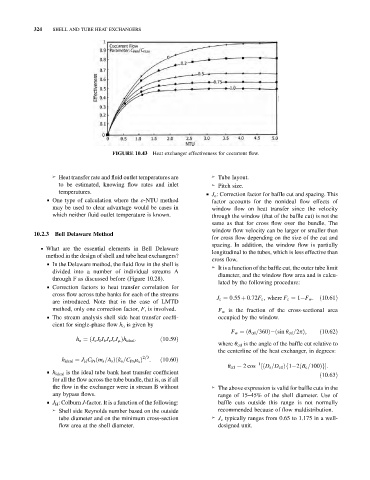
FIGURE 10.43 Heat exchanger effectiveness for cocurrent flow.
➢ Heat transfer rate and fluid outlet temperatures are ➢ Tube layout.
to be estimated, knowing flow rates and inlet ➢ Pitch size.
temperatures. & J c : Correction factor for baffle cut and spacing. This
& One type of calculation where the «-NTU method
factor accounts for the nonideal flow effects of
may be used to clear advantage would be cases in window flow on heat transfer since the velocity
which neither fluid outlet temperature is known. through the window (that of the baffle cut) is not the
same as that for cross flow over the bundle. The
window flow velocity can be larger or smaller than
for cross flow depending on the size of the cut and
10.2.3 Bell Delaware Method
spacing. In addition, the window flow is partially
. What are the essential elements in Bell Delaware
longitudinal to the tubes, which is less effective than
method in the design of shell and tube heat exchangers?
cross flow.
& In the Delaware method, the fluid flow in the shell is
➢ It is a function of the baffle cut, the outer tube limit
divided into a number of individual streams A
diameter, and the window flow area and is calcu-
through F as discussed before (Figure 10.28).
lated by the following procedure:
& Correction factors to heat transfer correlation for
cross flow across tube banks for each of the streams
J c ¼ 0:55 þ 0:72F c ; where F c ¼ 1 F w : ð10:61Þ
are introduced. Note that in the case of LMTD
method, only one correction factor, F, is involved. F w is the fraction of the cross-sectional area
& The stream analysis shell side heat transfer coeffi- occupied by the window.
cient for single-phase flow h o is given by
F w ¼ðu ctl =360Þ ðsin u ctl =2pÞ; ð10:62Þ
h o ¼ðJ c J l J b J s J r J m Þh ideal : ð10:59Þ
where u ctl is the angle of the baffle cut relative to
the centerline of the heat exchanger, in degrees:
2=3
h ideal ¼ J H C Ps ðm s =A s Þðk s =C Ps m Þ : ð10:60Þ
s
1
u ctl ¼ 2 cos ½ðD s =D ctl Þf1 2ðB c =100Þg:
& h ideal is the ideal tube bank heat transfer coefficient
ð10:63Þ
for all the flow across the tube bundle, that is, as if all
the flow in the exchanger were in stream B without ➢ The above expression is valid for baffle cuts in the
any bypass flows. range of 15–45% of the shell diameter. Use of
& J H : Colburn J-factor. It is a function of the following: baffle cuts outside this range is not normally
➢ Shell side Reynolds number based on the outside recommended because of flow maldistribution.
tube diameter and on the minimum cross-section ➢ J c typically ranges from 0.65 to 1.175 in a well-
flow area at the shell diameter. designed unit.

