


Page 528 - Forensic Structural Engineering Handbook
P. 528
14.18             MATERIAL-SPECIFIC FORENSIC ANALYSES

           Common Timber Construction and Analysis Problems
           Lateral Buckling.  Columns, arches, and truss members stressed in compression are usu-
           ally controlled by buckling or the interaction of buckling and compression, rather than by
           pure compression. Trusses and arches are rarely stable alone until secured into a diaphragm
           or some type of lateral bracing system; therefore buckling problems with these structural
           systems are most likely to occur during construction.
             Inadequate bracing has been the primary cause of truss problems that the author has
           investigated. Causes include inadequate temporary bracing, diaphragm construction lag-
           ging behind truss or arch placement, and pressure to release expensive rented cranes. (See
           Case Study 6, Rosemont Horizon Arena and Case Study 7, Port Hadlock Post Office.)
           Notching or Tapering Tension Face. Notching of timber structural members also severs
           stressed wood fibers. A combination of section loss, stress concentrations at the notch, and
           interaction of tension perpendicular to grain and shear stresses create a complex situation for
           analysis.
             Knowledge of fracture mechanics and stress concentrations beyond that possessed by
           most practicing structural engineers is required to understand the complex situation created
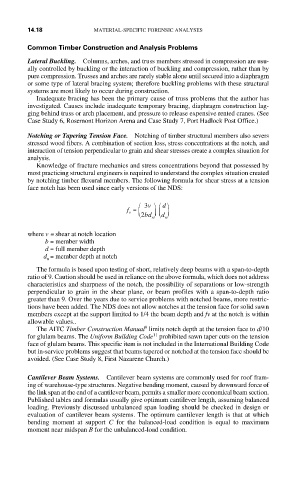
           by notching timber flexural members. The following formula for shear stress at a tension
           face notch has been used since early versions of the NDS:

                                               d
                                         ⎛ 3 v ⎞ ⎛ ⎞
                                     f =
                                      v  ⎜   ⎟ ⎜ ⎟
                                         ⎝2 bd ⎠ ⎝ ⎠
                                               d
                                            n   n
           where v = shear at notch location
                b = member width
                d = full member depth
               d = member depth at notch
                n
             The formula is based upon testing of short, relatively deep beams with a span-to-depth
           ratio of 9. Caution should be used in reliance on the above formula, which does not address
           characteristics and sharpness of the notch, the possibility of separations or low-strength
           perpendicular to grain in the shear plane, or beam profiles with a span-to-depth ratio
           greater than 9. Over the years due to service problems with notched beams, more restric-
           tions have been added. The NDS does not allow notches at the tension face for solid sawn
           members except at the support limited to 1/4 the beam depth and fv at the notch is within
           allowable values..
                                          9
             The AITC Timber Construction Manual limits notch depth at the tension face to d/10
                                             11
           for glulam beams. The Uniform Building Code prohibited sawn taper cuts on the tension
           face of glulam beams. This specific item is not included in the International Building Code
           but in-service problems suggest that beams tapered or notched at the tension face should be
           avoided. (See Case Study 8, First Nazarene Church.)
           Cantilever Beam Systems. Cantilever beam systems are commonly used for roof fram-
           ing of warehouse-type structures. Negative bending moment, caused by downward force of
           the link span at the end of a cantilever beam, permits a smaller more economical beam section.
           Published tables and formulas usually give optimum cantilever length, assuming balanced
           loading. Previously discussed unbalanced span loading should be checked in design or
           evaluation of cantilever beam systems. The optimum cantilever length is that at which
           bending moment at support  C for the balanced-load condition is equal to maximum
           moment near midspan B for the unbalanced-load condition.

