


Page 534 - Forensic Structural Engineering Handbook
P. 534
14.24             MATERIAL-SPECIFIC FORENSIC ANALYSES

           impact in design situations. Bridges and cranes usually have design impact values ranging
           from 10 to 50 percent so we usually can ignore that in timber design. That does not mean
           that we can ignore impact or that impact does not cause the “accumulation of fiber dam-
           age.” A dynamic analysis using the spring constants of the impacted and impacting mater-
           ial can quickly show the potential for severe overstress. (See Case Study 10, LaGrande
           Middle School Gym.) Windstorms cause trees to fall on timber structures and the forensic
           engineer is often called upon to investigate the situation. Although the cause of the prob-
           lem is usually evident, you will often be required to access the damage. Impact damage may
           have occurred to adjacent members still standing without visible effects from the falling
           tree. Frequently these members are light-framed timber trusses that are stiff (high spring
           constant) and therefore absorb a lot of the impact energy. In this situation it is better to make
           a conservative judgment to replace more trusses than are obviously damaged. The roof
           sheathing can pry down on adjacent trusses and pull down on the next adjacent trusses as
           the tree travels through the roof. The branches of the tree can absorb some of that impact
           energy. But it is probably cost-effective for the client to replace a few more trusses than for
           you to try to accurately model that dynamic problem.

           Eccentricity.  Eccentricity occasionally causes problems with columns and beams (in
           torsion) but is a common problem in trusses when connections do not align with the cen-
           troids of members. Even narrow axis eccentricity needs to be considered where connectors
           may be only on one face. (See Case Study 7, Port Hadlock Post Office.) Older bowstring
           trusses were often constructed using double chords with single webs in the plane between
           chords. In this case the webs could not be connected concentrically because of web-to-web
           interference. Bowstring trusses with small web forces were usually able to tolerate this
           eccentricity but more significant problems develop with straight top-chord trusses. Older
           precomputer structural analyses by graphic analysis or the method of joints assumed pinned
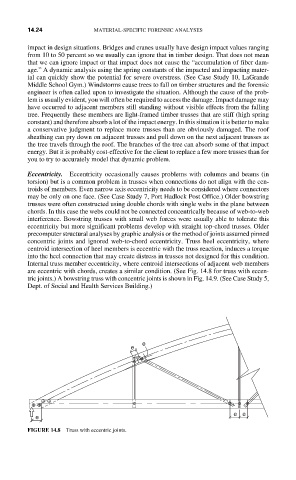
           concentric joints and ignored web-to-chord eccentricity. Truss heel eccentricity, where
           centroid intersection of heel members is eccentric with the truss reaction, induces a torque
           into the heel connection that may create distress in trusses not designed for this condition.
           Internal truss member eccentricity, where centroid intersections of adjacent web members
           are eccentric with chords, creates a similar condition. (See Fig. 14.8 for truss with eccen-
           tric joints.) A bowstring truss with concentric joints is shown in Fig. 14.9. (See Case Study 5,
           Dept. of Social and Health Services Building.)


                                          e
                                       e


                                                                  ee
             e
           FIGURE 14.8  Truss with eccentric joints.

