


Page 535 - Forensic Structural Engineering Handbook
P. 535
TIMBER STRUCTURES                   14.25


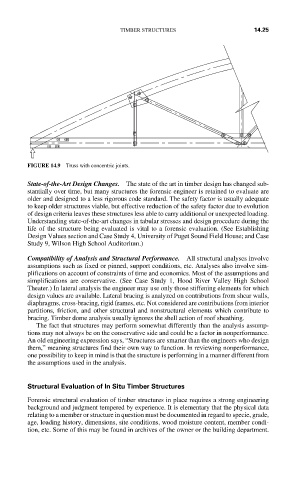
             FIGURE 14.9  Truss with concentric joints.

             State-of-the-Art Design Changes. The state of the art in timber design has changed sub-
             stantially over time, but many structures the forensic engineer is retained to evaluate are
             older and designed to a less rigorous code standard. The safety factor is usually adequate
             to keep older structures viable, but effective reduction of the safety factor due to evolution
             of design criteria leaves these structures less able to carry additional or unexpected loading.
             Understanding state-of-the-art changes in tabular stresses and design procedure during the
             life of the structure being evaluated is vital to a forensic evaluation. (See Establishing
             Design Values section and Case Study 4, University of Puget Sound Field House; and Case
             Study 9, Wilson High School Auditorium.)

             Compatibility of Analysis and Structural Performance.  All structural analyses involve
             assumptions such as fixed or pinned, support conditions, etc. Analyses also involve sim-
             plifications on account of constraints of time and economics. Most of the assumptions and
             simplifications are conservative. (See Case Study 1, Hood River Valley High School
             Theater.) In lateral analysis the engineer may use only those stiffening elements for which
             design values are available. Lateral bracing is analyzed on contributions from shear walls,
             diaphragms, cross-bracing, rigid frames, etc. Not considered are contributions from interior
             partitions, friction, and other structural and nonstructural elements which contribute to
             bracing. Timber dome analysis usually ignores the shell action of roof sheathing.
               The fact that structures may perform somewhat differently than the analysis assump-
             tions may not always be on the conservative side and could be a factor in nonperformance.
             An old engineering expression says, “Structures are smarter than the engineers who design
             them,” meaning structures find their own way to function. In reviewing nonperformance,
             one possibility to keep in mind is that the structure is performing in a manner different from
             the assumptions used in the analysis.


             Structural Evaluation of In Situ Timber Structures

             Forensic structural evaluation of timber structures in place requires a strong engineering
             background and judgment tempered by experience. It is elementary that the physical data
             relating to a member or structure in question must be documented in regard to specie, grade,
             age, loading history, dimensions, site conditions, wood moisture content, member condi-
             tion, etc. Some of this may be found in archives of the owner or the building department.

