


Page 117 - Foundations of Cognitive Psychology : Core Readings
P. 117
120   Daniel J. Levitin


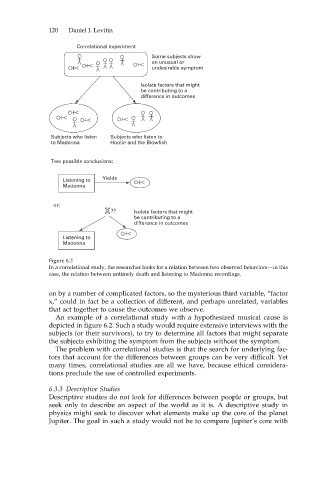
                Figure 6.2
                In a correlational study,the researcher looks for a relation between two observed behaviors—in this
                case,the relation between untimely death and listening to Madonna recordings.

                on by a number of complicated factors,so the mysterious third variable,‘‘factor
                x,’’ could in fact be a collection of different, and perhaps unrelated, variables
                that act together to cause the outcomes we observe.
                  An example of a correlational study with a hypothesized musical cause is
                depicted in figure 6.2. Such a study would require extensive interviews with the
                subjects (or their survivors),to try to determine all factors that might separate
                the subjects exhibiting the symptom from the subjects without the symptom.
                  The problem with correlational studies is that the search for underlying fac-
                tors that account for the differences between groups can be very difficult. Yet
                many times,correlational studies are all we have, because ethical considera-
                tions preclude the use of controlled experiments.
                6.3.3 Descriptive Studies
                Descriptive studies do not look for differences between people or groups,but
                seek only to describe an aspect of the world as it is. A descriptive study in
                physics might seek to discover what elements make up the core of the planet
                Jupiter. The goal in such a study would not be to compare Jupiter’s core with

