


Page 121 - Foundations of Cognitive Psychology : Core Readings
P. 121
124   Daniel J. Levitin

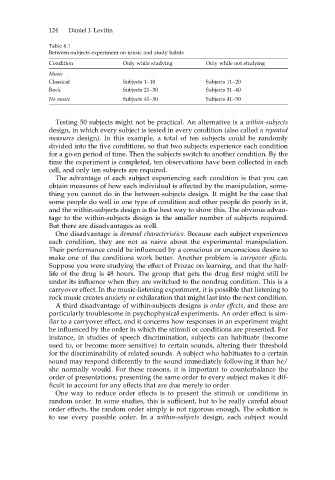
                Table 6.1
                Between-subjects experiment on music and study habits
                Condition             Only while studying      Only while not studying
                Music
                Classical             Subjects 1–10            Subjects 11–20
                Rock                  Subjects 21–30           Subjects 31–40
                No music              Subjects 41–50           Subjects 41–50


                  Testing 50 subjects might not be practical. An alternative is a within-subjects
                design,in which every subject is tested in every condition (also called a repeated
                measures design). In this example,a total of ten subjects could be randomly
                divided into the five conditions,so that two subjects experience each condition
                for a given period of time. Then the subjects switch to another condition. By the
                time the experiment is completed,ten observations have been collected in each
                cell,and only ten subjects are required.
                  The advantage of each subject experiencing each condition is that you can
                obtain measures of how each individual is affected by the manipulation,some-
                thing you cannot do in the between-subjects design. It might be the case that
                some people do well in one type of condition and other people do poorly in it,
                and the within-subjects design is the best way to show this. The obvious advan-
                tage to the within-subjects design is the smaller number of subjects required.
                But there are disadvantages as well.
                  One disadvantage is demand characteristics. Because each subject experiences
                each condition,they are not as naive about the experimental manipulation.
                Their performance could be influenced by a conscious or unconscious desire to
                make one of the conditions work better. Another problem is carryover effects.
                Suppose you were studying the effect of Prozac on learning,and that the half-
                life of the drug is 48 hours. The group that gets the drug first might still be
                under its influence when they are switched to the nondrug condition. This is a
                carryover effect. In the music-listening experiment,it is possible that listening to
                rock music creates anxiety or exhilaration that might last into the next condition.
                  A third disadvantage of within-subjects designs is order effects,and these are
                particularly troublesome in psychophysical experiments. An order effect is sim-
                ilar to a carryover effect,and it concerns how responses in an experiment might
                be influenced by the order in which the stimuli or conditions are presented. For
                instance,in studies of speech discrimination,subjects can habituate (become
                used to,or become more sensitive) to certain sounds, altering their threshold
                for the discriminability of related sounds. A subject who habituates to a certain
                sound may respond differently to the sound immediately following it than he/
                she normally would. For these reasons,it is important to counterbalance the
                order of presentations; presenting the same order to every subject makes it dif-
                ficult to account for any effects that are due merely to order.
                  One way to reduce order effects is to present the stimuli or conditions in
                random order. In some studies,this is sufficient,but to be really careful about
                order effects,the random order simply is not rigorous enough. The solution is
                to useevery possibleorder.Ina within-subjects design,each subject would

